Nomad 1

Tsegmid Tserennadmid , 2006 , Oil On Canvas

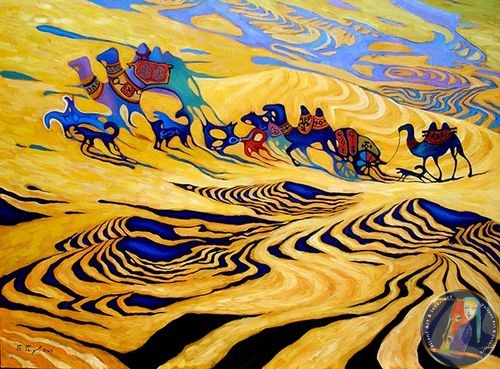
Nomad 1 is a quintessential example of Tsegmid Tserennadmid’s ability to fuse traditional Mongolian motifs with a Modern Expressionist sensibility. The painting captures the spiritual and physical essence of the Mongolian steppe, moving beyond mere representation into a realm of semi-abstraction.

  • Color Palette: The work features a sophisticated play of earthy tones—ochres, deep russets, and sandy beiges—contrasted against cooler, atmospheric blues or greys that suggest the vast Mongolian sky. The use of oil allows for a rich, textured surface where colors bleed into one another, mimicking the hazy horizon of the plains.

  • Brushwork: Consistent with his Expressionist style, the brushwork is energetic and visible. The artist uses broad, sweeping strokes to define the landscape, while sharper, more deliberate marks indicate the presence of nomadic life—perhaps the silhouette of a horse or the rounded form of a ger (yurt).

  • Abstraction: While the title grounds the piece in reality, the execution is highly Abstract. The “Nomad” is not necessarily a detailed figure but a feeling of movement and solitude. The 60 x 80 cm canvas provides a wide-angle perspective that emphasizes the isolation and grandeur of the nomadic lifestyle.


Context and Artistic Influence

Given Tserennadmid’s background as a high-ranking academic and leader in the Mongolian art community (serving as the President of the University of Art & Culture), Nomad 1 reflects a deep intellectual engagement with Mongolian heritage.

  • Landscape as Identity: The painting is less about a specific location and more about the “Landscape” of the Mongolian soul. It bridges the gap between the ancient tradition of the steppes and the 21st-century global art stage.

  • Modernity vs. Tradition: Created in 2006, just before his major international exhibitions in Montreal, Las Vegas, and London, this piece represents the artist at the height of his career, successfully exporting Mongolian contemporary aesthetics to a Western audience.
  • Tsegmid Tserennadmid
  • Abstract, Modern/Contemporary
  • Oil On Canvas
  • TSG48/003
  • 60 x 80cm
  • Mongolian Art Gallery

Add Your Comment

Mongolian Art Gallery © 2025. All Rights Reserved
Privacy Policy / Terms of Use

Nomad 1 is a quintessential example of Tsegmid Tserennadmid’s ability to fuse traditional Mongolian motifs with a Modern Expressionist sensibility. The painting captures the spiritual and physical essence of the Mongolian steppe, moving beyond mere representation into a realm of semi-abstraction.

  • Color Palette: The work features a sophisticated play of earthy tones—ochres, deep russets, and sandy beiges—contrasted against cooler, atmospheric blues or greys that suggest the vast Mongolian sky. The use of oil allows for a rich, textured surface where colors bleed into one another, mimicking the hazy horizon of the plains.

  • Brushwork: Consistent with his Expressionist style, the brushwork is energetic and visible. The artist uses broad, sweeping strokes to define the landscape, while sharper, more deliberate marks indicate the presence of nomadic life—perhaps the silhouette of a horse or the rounded form of a ger (yurt).

  • Abstraction: While the title grounds the piece in reality, the execution is highly Abstract. The “Nomad” is not necessarily a detailed figure but a feeling of movement and solitude. The 60 x 80 cm canvas provides a wide-angle perspective that emphasizes the isolation and grandeur of the nomadic lifestyle.


Context and Artistic Influence

Given Tserennadmid’s background as a high-ranking academic and leader in the Mongolian art community (serving as the President of the University of Art & Culture), Nomad 1 reflects a deep intellectual engagement with Mongolian heritage.

  • Landscape as Identity: The painting is less about a specific location and more about the “Landscape” of the Mongolian soul. It bridges the gap between the ancient tradition of the steppes and the 21st-century global art stage.

  • Modernity vs. Tradition: Created in 2006, just before his major international exhibitions in Montreal, Las Vegas, and London, this piece represents the artist at the height of his career, successfully exporting Mongolian contemporary aesthetics to a Western audience.