
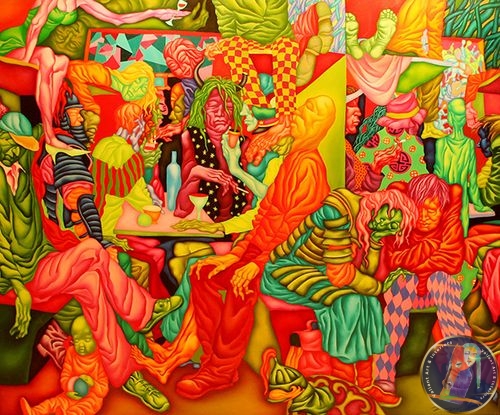
Night Train

Enkhjargal Tsagaandari , 2005 , Oil On Canvas

Night Train, a 2005 oil on canvas masterpiece by the renowned Mongolian artist Enkhjargal Tsagaandari, is a profound synthesis of Mongolian landscape tradition and modern abstract expressionism. Measuring an expansive 150 x 180 cm, the work utilizes its large scale to immerse the viewer in a nocturnal world where industry and nature collide in a rhythmic, atmospheric dance.

Visual Composition and Narrative

The painting captures a singular moment of transit through a vast, darkened expanse. Rather than a literal depiction of a locomotive, Tsagaandari employs his signature Contemporary-Figurative style to evoke the essence of the journey:

  • The Subject: The “Night Train” is rendered as a sequence of luminous, rhythmic shapes cutting through the composition. It acts as a bridge between the physical geography of the Mongolian steppe and the psychological space of travel.

  • The Landscape: True to his roots in Ulaanbaatar and his experience with monumental art, Tsagaandari treats the background not as empty space, but as a living entity. The landscape is felt through deep, layered tones—indigoes, charcoal grays, and obsidian—suggesting the immense silence of the countryside at night.

  • Movement and Light: The artist uses the interplay of light and shadow to create a sense of velocity. Bursts of ochre, pale yellow, or stark white represent the train’s windows or headlights, piercing the gloom and casting long, flickering reflections that blur the line between the mechanical and the natural.

Stylistic Influence and Execution

Tsagaandari’s background as a teacher at the College of Fine Art and his work in monumental art are evident in the painting’s structural integrity.

  • Technique: The oil paint is applied with a sophisticated blend of palette knife work and soft glazing. This creates a tactile surface where the “Abstract” elements of the smoke and steam merge seamlessly into the “Nature” of the hills.

  • Atmosphere: There is a distinct “Modern” sensibility in how the artist handles the horizon. The painting avoids traditional perspective, opting instead for a flattened, more emotive space that reflects the disorientation and isolation one feels during a long night journey.

  • Cultural Context: While the train is a symbol of modernity, the vastness it traverses speaks to the eternal Mongolian landscape. The work captures the transition of Mongolia itself—a culture moving from its nomadic roots (the land) toward an industrial future (the train).
  • Enkhjargal Tsagaandari
  • Abstract, Photorealism
  • Oil On Canvas
  • ENJ25/027
  • 150 x 180cm
  • Mongolian Art Gallery

Add Your Comment

Mongolian Art Gallery © 2025. All Rights Reserved
Privacy Policy / Terms of Use

Night Train, a 2005 oil on canvas masterpiece by the renowned Mongolian artist Enkhjargal Tsagaandari, is a profound synthesis of Mongolian landscape tradition and modern abstract expressionism. Measuring an expansive 150 x 180 cm, the work utilizes its large scale to immerse the viewer in a nocturnal world where industry and nature collide in a rhythmic, atmospheric dance.

Visual Composition and Narrative

The painting captures a singular moment of transit through a vast, darkened expanse. Rather than a literal depiction of a locomotive, Tsagaandari employs his signature Contemporary-Figurative style to evoke the essence of the journey:

  • The Subject: The “Night Train” is rendered as a sequence of luminous, rhythmic shapes cutting through the composition. It acts as a bridge between the physical geography of the Mongolian steppe and the psychological space of travel.

  • The Landscape: True to his roots in Ulaanbaatar and his experience with monumental art, Tsagaandari treats the background not as empty space, but as a living entity. The landscape is felt through deep, layered tones—indigoes, charcoal grays, and obsidian—suggesting the immense silence of the countryside at night.

  • Movement and Light: The artist uses the interplay of light and shadow to create a sense of velocity. Bursts of ochre, pale yellow, or stark white represent the train’s windows or headlights, piercing the gloom and casting long, flickering reflections that blur the line between the mechanical and the natural.

Stylistic Influence and Execution

Tsagaandari’s background as a teacher at the College of Fine Art and his work in monumental art are evident in the painting’s structural integrity.

  • Technique: The oil paint is applied with a sophisticated blend of palette knife work and soft glazing. This creates a tactile surface where the “Abstract” elements of the smoke and steam merge seamlessly into the “Nature” of the hills.

  • Atmosphere: There is a distinct “Modern” sensibility in how the artist handles the horizon. The painting avoids traditional perspective, opting instead for a flattened, more emotive space that reflects the disorientation and isolation one feels during a long night journey.

  • Cultural Context: While the train is a symbol of modernity, the vastness it traverses speaks to the eternal Mongolian landscape. The work captures the transition of Mongolia itself—a culture moving from its nomadic roots (the land) toward an industrial future (the train).