
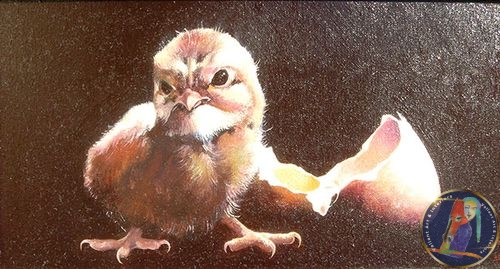
New Life

Olzbaatar Tserendorj , 2005 , Oil On Canvas

In “New Life,” Olzbaatar Tserendorj utilizes his mastery of photorealism and figurative realism to capture a moment of profound serenity and primal connection. Despite the painting’s modest dimensions, it carries a heavy emotional weight, focusing on the intimate bond between a mother and her newborn within the vast, rugged context of the Mongolian landscape.

Composition and Subject Matter

The composition is tightly focused, emphasizing the tactile reality of the subjects. A mother, depicted with soft, naturalistic features characteristic of Tserendorj’s portraiture style, cradles her infant. The “New Life” referenced in the title is literal—a delicate, rosy-cheeked babe wrapped in heavy, traditional textiles.

  • The Mother: Her expression is one of quiet exhaustion and deep contentment. The artist captures the subtle play of light on her skin, highlighting the influence of his Russian academic training at the Surikov Painting Academy.

  • The Infant: The child serves as the focal point of light and hope, contrasted against the darker, weathered textures of the mother’s clothing and the surrounding environment.

Style and Technique

Tserendorj’s background in Moscow’s Surikov Academy is evident in the technical precision of the brushwork.

  • Texture: There is a brilliant contrast between the soft skin of the infant and the coarse, heavy wool of the Mongolian deel (traditional tunic). The artist meticulously renders the fibers of the fabric and the stray hairs of the mother’s head, blurring the line between oil painting and photography.

  • Color Palette: The palette is grounded in earthy, natural tones—ochres, deep browns, and muted reds—which root the figures in the Mongolian landscape. The lighting is soft and directional, as if filtered through the opening of a ger (yurt), creating a chiaroscuro effect that adds a sense of sacredness to the scene.
  • Olzbaatar Tserendorj
  • Figurative, Minimalist
  • Oil On Canvas
  • OLZ44/002
  • 17 x 31cm
  • Mongolian Art Gallery

Add Your Comment

Mongolian Art Gallery © 2025. All Rights Reserved
Privacy Policy / Terms of Use

In “New Life,” Olzbaatar Tserendorj utilizes his mastery of photorealism and figurative realism to capture a moment of profound serenity and primal connection. Despite the painting’s modest dimensions, it carries a heavy emotional weight, focusing on the intimate bond between a mother and her newborn within the vast, rugged context of the Mongolian landscape.

Composition and Subject Matter

The composition is tightly focused, emphasizing the tactile reality of the subjects. A mother, depicted with soft, naturalistic features characteristic of Tserendorj’s portraiture style, cradles her infant. The “New Life” referenced in the title is literal—a delicate, rosy-cheeked babe wrapped in heavy, traditional textiles.

  • The Mother: Her expression is one of quiet exhaustion and deep contentment. The artist captures the subtle play of light on her skin, highlighting the influence of his Russian academic training at the Surikov Painting Academy.

  • The Infant: The child serves as the focal point of light and hope, contrasted against the darker, weathered textures of the mother’s clothing and the surrounding environment.

Style and Technique

Tserendorj’s background in Moscow’s Surikov Academy is evident in the technical precision of the brushwork.

  • Texture: There is a brilliant contrast between the soft skin of the infant and the coarse, heavy wool of the Mongolian deel (traditional tunic). The artist meticulously renders the fibers of the fabric and the stray hairs of the mother’s head, blurring the line between oil painting and photography.

  • Color Palette: The palette is grounded in earthy, natural tones—ochres, deep browns, and muted reds—which root the figures in the Mongolian landscape. The lighting is soft and directional, as if filtered through the opening of a ger (yurt), creating a chiaroscuro effect that adds a sense of sacredness to the scene.