

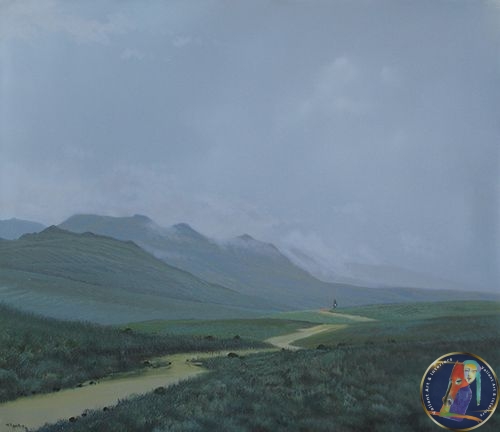
Nature 6 is a masterful example of Photorealism and Contemporary Realism, reflecting Khurelbaatar Choindon’s rigorous academic training at the Repin Academy of Fine Art. The painting captures a serene, hyper-detailed fragment of the Mongolian wilderness, focusing on the tactile relationship between water, stone, and light.
Detailed Description
The composition is an intimate, “close-up” landscape that eschews the vastness of the Mongolian steppe for the intricate textures of a riverbed.
The Foreground: The lower half of the canvas is dominated by a collection of smooth, weathered river stones submerged in crystal-clear water. Choindon employs a sophisticated use of glazing to create the illusion of depth, showing the subtle distortion of the rocks beneath the surface.
The Element of Water: The water is rendered with such precision that it appears almost liquid on the canvas. Thin, white ripples and soft reflections dance across the surface, catching the light and suggesting a gentle, rhythmic current.
Texture and Palette: The color palette is earthy and organic, composed of muted greys, ochres, and deep mossy greens. The artist contrasts the cold, hard surfaces of the stones with the fluid, transparent nature of the water. Each pebble is treated as an individual portrait, with minute cracks, mineral veins, and patches of algae rendered in high definition.
Atmosphere: Despite the technical “hardness” of Photorealism, the work exudes a quiet, meditative atmosphere. There is a profound sense of stillness and purity, a hallmark of Choindon’s “Nature” series, which seeks to elevate the mundane details of the natural world into objects of spiritual contemplation.
Artistic Context
Painted in 2006, during Choindon’s tenure as Vice Chairman of the Union of Mongolian Artists (UMA), this work represents the peak of his technical prowess. His Russian academic background is evident in the disciplined brushwork, yet the subject matter remains deeply rooted in the pristine, untouched landscapes of his native Mongolia.
The 61 x 71 cm format provides a window-like view into an environment that feels both expansive in its detail and intimate in its scope, bridging the gap between traditional landscape painting and modern figurative precision.
