
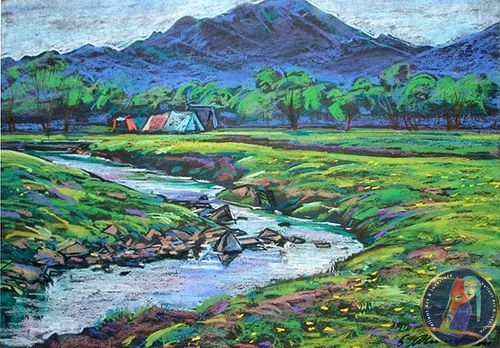
Nature 58 is a masterclass in Mongolian Realism, capturing the serene and rugged essence of the Central Asian landscape. Executed in soft pastel, the work possesses a tactile, velvety quality that perfectly suits the hazy, atmospheric light of the Mongolian wilderness.
Composition and Subject Matter The painting depicts a tranquil natural scene, likely inspired by the vast steppes or the foothills of the Altai Mountains. The composition is balanced, utilizing a traditional horizon line that draws the viewer’s eye across a sprawling terrain.
Forefround: Features delicate textures of local flora—perhaps hardy grasses or low-lying shrubs—rendered with precise strokes that showcase Badarch’s technical skill.
Midground: Often characterized by the rolling contours of the land, the artist uses subtle shifts in value to create a sense of immense scale and distance.
Background: Distant peaks or a vast, open sky dominate the upper portion of the work. The sky is rendered with soft gradients, suggesting the specific “blue sky” clarity for which Mongolia is famous, or perhaps the golden hue of a late afternoon sun.
Color Palette The palette is earthy and sophisticated. Expect a harmony of:
Ochres and Umbers: Representing the sun-drenched earth and dried grasses.
Cool Azures and Slate Greys: Defining the shadows of the hills and the depth of the sky.
Muted Greens: Providing life to the sparse vegetation.
Artistic Style and Context
Tumurbaatar Badarch’s work is deeply influenced by his rigorous academic training at the College of Fine Art in Ulaanbaatar and the prestigious Mukhin Institute in St. Petersburg. This Russian influence is evident in the painting’s structural integrity and its commitment to Realism.
However, the soul of the piece remains distinctly Mongolian. Unlike the rigid industrial realism often found in mid-century Soviet art, Badarch’s Nature series focuses on the spiritual and quiet power of the untouched environment. By 2006, when this piece was created, Badarch had refined his ability to use pastel not just as a colorant, but as a medium to capture the very air and temperature of the landscape.