
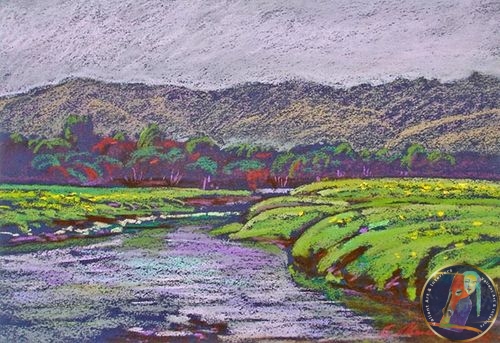
Nature 56 is a serene and masterfully rendered landscape that exemplifies Tumurbaatar Badarch’s commitment to classical realism and the natural world. Executed in 2006, this work utilizes the soft, blendable qualities of pastel on paper to capture the atmospheric essence of the Mongolian wilderness.
Composition and Technique: The composition follows a traditional realist approach, using a balanced perspective to draw the viewer’s eye through the terrain. Badarch’s training at the Mukhin Institute in St. Petersburg is evident in his sophisticated handling of light and shadow. The pastel medium is layered to create a velvety texture, allowing for soft transitions in the sky and sharp, precise strokes to define the ruggedness of the earth and vegetation.
Subject Matter: True to the artist’s roots, the painting likely depicts a vista inspired by the Mongolian landscape. The focus is on the interplay between the elements—the vastness of the sky meeting the undulating contours of the land. There is a sense of stillness and timelessness, characteristic of the “Oron Zai” (Space) art association’s aesthetic, which often explores the relationship between nature and spatial harmony.
Color Palette: The palette is dominated by organic, earthy tones. Expect a range of muted ochres, deep browns, and subtle greens, contrasted against a sky that may feature delicate blues or the warm, hazy grays of a distant horizon. The use of pastel allows for a luminous quality, making the natural light feel diffused and authentic to a specific time of day.
Context and Artistic Significance
Badarch belongs to a generation of Mongolian artists who bridged the gap between rigorous Soviet-era academic training and the burgeoning contemporary movements of the 1990s.
“Nature 56 is not merely a record of a place, but a reflection of the artist’s deep-seated connection to the Mongolian environment, rendered with the technical precision of the Russian Realist tradition.”