
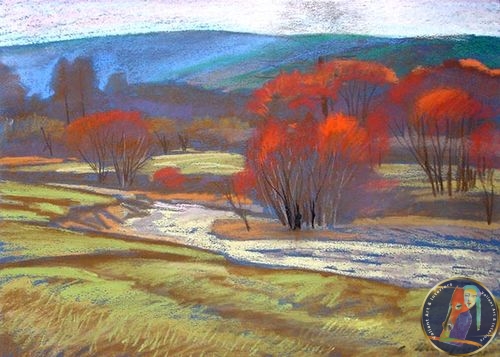
In the work Nature 51, Tumurbaatar Badarch captures the silent, expansive soul of the Mongolian landscape through the delicate and tactile medium of pastel on paper. Measuring 30 x 40cm, this piece is a testament to the artist’s mastery of Realism, honed during his rigorous academic training in Ulaanbaatar and St. Petersburg.
Visual Composition and Atmosphere
The painting likely depicts a serene vista, characterized by the soft, velvet textures inherent to pastel work. Badarch’s style is known for its atmospheric depth, often focusing on the interplay of light across the vast Mongolian steppes or rugged mountain terrains.
Color Palette: Given the “Nature” series’ focus, expect a harmonious blend of earthy ochres, deep moss greens, and the ethereal blues of the “Eternal Blue Sky.” The artist uses the blending capabilities of pastels to create seamless transitions in the sky and soft, blurred horizons that suggest immense distance.
Technique: His brushwork—or in this case, stroke work—reflects a disciplined Realism. Every ridge of a hill or clump of hardy grassland is rendered with an eye for topographical accuracy, yet softened by a poetic, almost meditative light.
Context of the Work
Created in 2006, Nature 51 represents Badarch in his artistic maturity. Having exhibited globally from Italy to Hong Kong and Korea, this piece distills his international experiences back into the singular subject of his homeland’s environment.
About the Artist: Tumurbaatar Badarch
Badarch is a significant figure in contemporary Mongolian art, bridging the gap between traditional Mongolian aesthetics and European academic excellence.
Academic Foundation
1978: Graduated from the College of Fine Art, Ulaanbaatar, establishing his roots in Mongolian draftsmanship.
1985: Graduated from the prestigious Mukhin Institute of Industrial Art in St. Petersburg, Russia, where he mastered the techniques of Russian Realism and a sophisticated understanding of form and light.
Legacy and Reach Since 1978, Badarch has been a mainstay in the Union of Mongolian Artists (UMA) exhibitions. His work serves as a cultural bridge, showcased in major international exhibitions across Europe and Asia, including:
The “Oron Zai” (Space) Association: A group known for pushing the boundaries of Mongolian art while respecting its core identity.
Solo Success: His 2003 solo exhibition, Gerege, marked a high point in his career, solidifying his reputation as a premier landscape realist.