
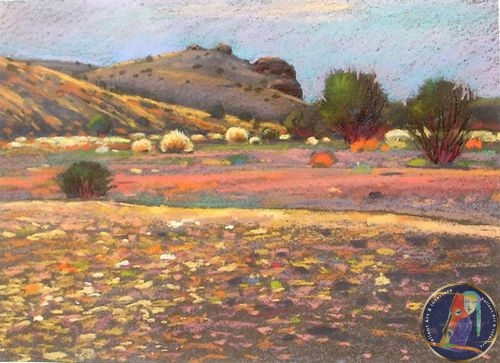
Nature 5

Tumurbaatar Badarch , 2006 , Pastel On Paper

Nature 5 is a testament to Tumurbaatar Badarch’s mastery of the pastel medium and his deep-seated connection to the Mongolian landscape. Created in 2006, this work reflects the artist’s formal training in both Ulaanbaatar and St. Petersburg, blending a rigorous Russian academic foundation with a poetic, nomadic sensibility.

Visual Composition and Style

The painting is rendered in a Realist style, characterized by a meticulous attention to the subtle textures of the natural world. Despite its relatively intimate scale (30 x 40 cm), the composition evokes a sense of vast, quiet space.

  • Atmospheric Perspective: Badarch utilizes the soft, blendable qualities of pastel to create a sophisticated atmospheric depth. The transition from the sharp details of the foreground to the hazy, ethereal qualities of the distant horizon suggests the clear, high-altitude light typical of the Mongolian plateau.

  • Color Palette: The palette is likely dominated by earthy, organic tones—ochres, muted greens, and soft ambers—punctuated by the cool blues or greys of a sweeping sky. The use of pastel allows for a velvety matte finish, giving the landscape a tactile, almost skin-like quality.

  • Texture: The artist leverages the grain of the paper to mimic the ruggedness of the terrain. One can sense the dry grass, the weathered stone, or the softness of distant slopes through varied stroke pressures and layering techniques.

Artistic Context

Born in Ulaanbaatar in 1958, Badarch belongs to a generation of Mongolian artists who bridged the gap between traditional socialist realism and a more personal, expressive engagement with nature.

His education at the College of Fine Art in Ulaanbaatar provided him with the local cultural vernacular, while his time at the Mukhin Institute in St. Petersburg (a prestigious center for industrial and decorative arts) refined his technical precision and understanding of form.

  • Tumurbaatar Badarch
  • Nature, Photorealism
  • Pastel On Paper
  • TUM67/039
  • 30 x 40cm
  • Mongolian Art Gallery

Add Your Comment

Mongolian Art Gallery © 2025. All Rights Reserved
Privacy Policy / Terms of Use

Nature 5 is a testament to Tumurbaatar Badarch’s mastery of the pastel medium and his deep-seated connection to the Mongolian landscape. Created in 2006, this work reflects the artist’s formal training in both Ulaanbaatar and St. Petersburg, blending a rigorous Russian academic foundation with a poetic, nomadic sensibility.

Visual Composition and Style

The painting is rendered in a Realist style, characterized by a meticulous attention to the subtle textures of the natural world. Despite its relatively intimate scale (30 x 40 cm), the composition evokes a sense of vast, quiet space.

  • Atmospheric Perspective: Badarch utilizes the soft, blendable qualities of pastel to create a sophisticated atmospheric depth. The transition from the sharp details of the foreground to the hazy, ethereal qualities of the distant horizon suggests the clear, high-altitude light typical of the Mongolian plateau.

  • Color Palette: The palette is likely dominated by earthy, organic tones—ochres, muted greens, and soft ambers—punctuated by the cool blues or greys of a sweeping sky. The use of pastel allows for a velvety matte finish, giving the landscape a tactile, almost skin-like quality.

  • Texture: The artist leverages the grain of the paper to mimic the ruggedness of the terrain. One can sense the dry grass, the weathered stone, or the softness of distant slopes through varied stroke pressures and layering techniques.

Artistic Context

Born in Ulaanbaatar in 1958, Badarch belongs to a generation of Mongolian artists who bridged the gap between traditional socialist realism and a more personal, expressive engagement with nature.

His education at the College of Fine Art in Ulaanbaatar provided him with the local cultural vernacular, while his time at the Mukhin Institute in St. Petersburg (a prestigious center for industrial and decorative arts) refined his technical precision and understanding of form.