
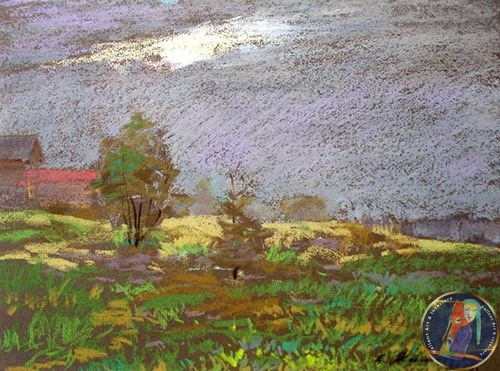
Nature 46 is a compelling testament to Tumurbaatar Badarch’s mastery of the pastel medium, showcasing the serene and rugged beauty of the Mongolian landscape. Created in 2006, this 30 x 40 cm work on paper reflects the artist’s deep-seated connection to his homeland, filtered through a lens of sophisticated Realism.
Visual Composition and Style
The painting captures a tranquil yet powerful moment in nature. Given Badarch’s background at the Mukhin Institute in St. Petersburg, the work likely employs a rigorous structural foundation characteristic of the Russian academic tradition, blended with a distinctly Mongolian sensitivity to light and space.
Medium & Texture: The use of pastel on paper allows for a soft, atmospheric quality. Badarch utilizes the tactile nature of pastels to build layers of color, creating a rich texture that mimics the organic surfaces of stone, earth, and flora.
Color Palette: The palette likely consists of earthy, muted tones—ochres, deep greens, and cool blues—punctuated by the soft, diffused light typical of high-altitude Mongolian environments.
Realism: While the style is firmly rooted in Realism, it is not a sterile reproduction. There is a “living” quality to the work, where the artist captures the movement of wind through grass or the shifting shadows on a mountainside.
Artistic Context and Background
Tumurbaatar Badarch, born in 1958 in Ulaanbaatar, is a pivotal figure in contemporary Mongolian landscape art. Nature 46 was produced during a mature phase of his career, following decades of international exposure.
Influence of Education: The precision in his “Nature” series owes much to his dual education at the College of Fine Art (Ulaanbaatar) and the Mukhin Institute (Russia). This combination of local inspiration and international technical training allows him to elevate a simple landscape into a profound study of form.
The “Oron Zai” Connection: As a regular contributor to the “Oron Zai” (Space) art association exhibitions since 1992, Badarch’s work explores the concept of “space”—not just as a physical distance, but as a spiritual presence within the Mongolian steppe.