Nature 44

Tumurbaatar Badarch , 2006 , Pastel On Paper

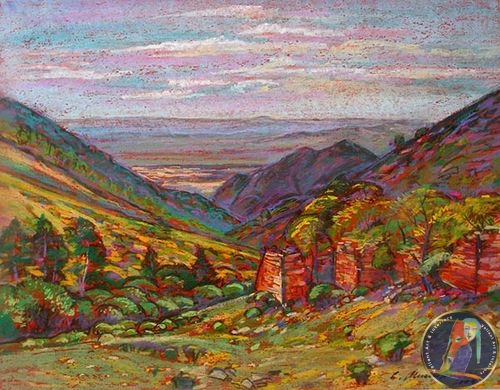
Nature 44 is a masterful exercise in Mongolian Realism, capturing the quiet, atmospheric transition of a landscape through the soft, tactile medium of pastel. Given Badarch’s stylistic roots and his education at the Mukhin Institute in St. Petersburg, the work likely emphasizes a sophisticated interplay of light and texture rather than sharp, photographic lines.

  • Composition: The painting likely follows a classic horizontal landscape orientation. As is characteristic of Badarch’s “Nature” series, the composition likely focuses on a specific, intimate slice of the Mongolian wilderness—perhaps a cluster of trees, a rolling steppe under a heavy sky, or the edge of a forest.

  • The Medium: The choice of pastel on paper is significant. Unlike oil, pastel allows for a velvet-like finish and seamless blending. This creates a soft-focus effect that mimics the hazy quality of natural light or the gentle frost of a Mongolian morning.

  • Color Palette: Expect a palette dominated by earthy, muted tones—ochres, deep ambers, and cool greys—punctuated by the vibrant, yet soft, hues typical of high-quality pigments. The “Realism” associated with Badarch is not just about form, but about the “truth” of the atmosphere, often conveying a sense of solitude and vastness.

  • The Subject: In Nature 44, the focus is likely on the resilience of the natural world. Badarch’s landscapes often omit human figures, instead allowing the topography and flora to speak for the cultural soul of Mongolia. The 30 x 40 cm scale suggests an intimate viewing experience, inviting the observer to look closely at the rhythmic strokes of pastel that define the terrain.


About the Artist: Tumurbaatar Badarch

Born in 1958 in Ulaanbaatar, Badarch represents a bridge between traditional Mongolian aesthetics and rigorous Russian academic training.

  • Artistic Pedigree: His education at the College of Fine Art in Ulaanbaatar provided a foundation in Mongolian heritage, while his time at the Mukhin Institute in St. Petersburg (now the Saint Petersburg Stieglitz State Academy of Art and Design) refined his technical execution and understanding of light.

  • Global Reach: Since 1978, his work has been a staple of the Union of Mongolian Artists (UMA). His international exhibition history—spanning Italy, Korea, France, and Lithuania—highlights his role as a cultural ambassador, bringing the specific light and “space” (Oron Zai) of the Mongolian landscape to a global audience.
  • Tumurbaatar Badarch
  • Abstract, Nature
  • Pastel On Paper
  • TUM67/003
  • 30 x 40cm
  • Mongolian Art Gallery

Add Your Comment

Mongolian Art Gallery © 2025. All Rights Reserved
Privacy Policy / Terms of Use

Nature 44 is a masterful exercise in Mongolian Realism, capturing the quiet, atmospheric transition of a landscape through the soft, tactile medium of pastel. Given Badarch’s stylistic roots and his education at the Mukhin Institute in St. Petersburg, the work likely emphasizes a sophisticated interplay of light and texture rather than sharp, photographic lines.

  • Composition: The painting likely follows a classic horizontal landscape orientation. As is characteristic of Badarch’s “Nature” series, the composition likely focuses on a specific, intimate slice of the Mongolian wilderness—perhaps a cluster of trees, a rolling steppe under a heavy sky, or the edge of a forest.

  • The Medium: The choice of pastel on paper is significant. Unlike oil, pastel allows for a velvet-like finish and seamless blending. This creates a soft-focus effect that mimics the hazy quality of natural light or the gentle frost of a Mongolian morning.

  • Color Palette: Expect a palette dominated by earthy, muted tones—ochres, deep ambers, and cool greys—punctuated by the vibrant, yet soft, hues typical of high-quality pigments. The “Realism” associated with Badarch is not just about form, but about the “truth” of the atmosphere, often conveying a sense of solitude and vastness.

  • The Subject: In Nature 44, the focus is likely on the resilience of the natural world. Badarch’s landscapes often omit human figures, instead allowing the topography and flora to speak for the cultural soul of Mongolia. The 30 x 40 cm scale suggests an intimate viewing experience, inviting the observer to look closely at the rhythmic strokes of pastel that define the terrain.


About the Artist: Tumurbaatar Badarch

Born in 1958 in Ulaanbaatar, Badarch represents a bridge between traditional Mongolian aesthetics and rigorous Russian academic training.

  • Artistic Pedigree: His education at the College of Fine Art in Ulaanbaatar provided a foundation in Mongolian heritage, while his time at the Mukhin Institute in St. Petersburg (now the Saint Petersburg Stieglitz State Academy of Art and Design) refined his technical execution and understanding of light.

  • Global Reach: Since 1978, his work has been a staple of the Union of Mongolian Artists (UMA). His international exhibition history—spanning Italy, Korea, France, and Lithuania—highlights his role as a cultural ambassador, bringing the specific light and “space” (Oron Zai) of the Mongolian landscape to a global audience.