Nature 4

Tumurbaatar Badarch , 2006 , Pastel On Paper

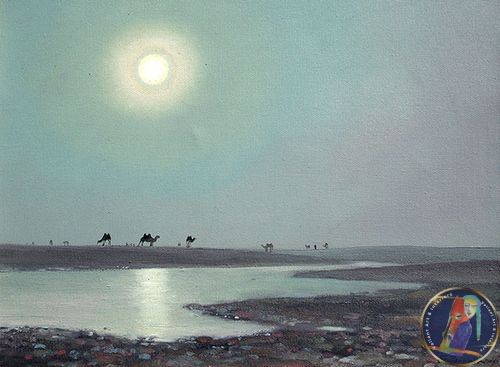
Nature 4 is a serene testament to the mastery of Tumurbaatar Badarch, a prominent figure in Mongolian contemporary realism. Created in 2006, this work utilizes pastel on paper to capture a moment of quietude within the Mongolian landscape, rendered in a compact 30 x 40cm format that invites the viewer into an intimate encounter with the wilderness.

Composition and Visual Elements

The painting is rooted in the academic traditions Badarch honed at the College of Fine Art in Ulaanbaatar and the Mukhin Institute in St. Petersburg. The composition likely features a balanced, realist perspective, characteristic of his “Oron Zai” (Space) association influence.

  • Medium & Texture: The choice of pastel allows for a soft, atmospheric quality. Badarch utilizes the medium to create velvety transitions in the sky and a tactile, granular feel for the earth and foliage. The blending of pigments suggests a hazy, ethereal light common in the high altitudes of Mongolia.

  • Color Palette: Expect a sophisticated harmony of earth tones—ochres, deep umbers, and sage greens—contrasted against the cool, expansive blues or soft greys of a northern sky. The “Nature” series is known for its ability to convey the specific “temperature” of a landscape through color.

  • Style: While strictly Realism, there is an underlying poetic stillness. The detail is meticulous but not clinical; it captures the essence of the environment rather than just a photographic replica.


About the Artist: Tumurbaatar Badarch

Born in 1958 in Ulaanbaatar, Badarch belongs to a generation of Mongolian artists who successfully bridged the gap between Soviet-era formal training and the post-1990s push for national identity and creative freedom.

  • Artistic Pedigree: His education in St. Petersburg (then Leningrad) provided him with a rigorous foundation in industrial and fine arts, which is evident in the structural integrity of his landscapes.

  • Legacy: Since 1978, his work has been a staple of the Union of Mongolian Artists (UMA). His participation in international exhibitions—from the “Mongolian Highlights” in Lithuania to various showcases in Korea, Italy, and France—positions him as a cultural ambassador of the Mongolian steppe.
  • Tumurbaatar Badarch
  • Calligraphy, Nature
  • Oil On Canvas
  • TUM67/040
  • 30 x 40cm
  • Mongolian Art Gallery

Add Your Comment

Mongolian Art Gallery © 2025. All Rights Reserved
Privacy Policy / Terms of Use

Nature 4 is a serene testament to the mastery of Tumurbaatar Badarch, a prominent figure in Mongolian contemporary realism. Created in 2006, this work utilizes pastel on paper to capture a moment of quietude within the Mongolian landscape, rendered in a compact 30 x 40cm format that invites the viewer into an intimate encounter with the wilderness.

Composition and Visual Elements

The painting is rooted in the academic traditions Badarch honed at the College of Fine Art in Ulaanbaatar and the Mukhin Institute in St. Petersburg. The composition likely features a balanced, realist perspective, characteristic of his “Oron Zai” (Space) association influence.

  • Medium & Texture: The choice of pastel allows for a soft, atmospheric quality. Badarch utilizes the medium to create velvety transitions in the sky and a tactile, granular feel for the earth and foliage. The blending of pigments suggests a hazy, ethereal light common in the high altitudes of Mongolia.

  • Color Palette: Expect a sophisticated harmony of earth tones—ochres, deep umbers, and sage greens—contrasted against the cool, expansive blues or soft greys of a northern sky. The “Nature” series is known for its ability to convey the specific “temperature” of a landscape through color.

  • Style: While strictly Realism, there is an underlying poetic stillness. The detail is meticulous but not clinical; it captures the essence of the environment rather than just a photographic replica.


About the Artist: Tumurbaatar Badarch

Born in 1958 in Ulaanbaatar, Badarch belongs to a generation of Mongolian artists who successfully bridged the gap between Soviet-era formal training and the post-1990s push for national identity and creative freedom.

  • Artistic Pedigree: His education in St. Petersburg (then Leningrad) provided him with a rigorous foundation in industrial and fine arts, which is evident in the structural integrity of his landscapes.

  • Legacy: Since 1978, his work has been a staple of the Union of Mongolian Artists (UMA). His participation in international exhibitions—from the “Mongolian Highlights” in Lithuania to various showcases in Korea, Italy, and France—positions him as a cultural ambassador of the Mongolian steppe.