
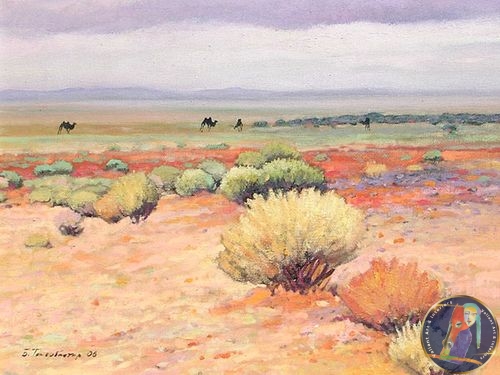
Nature 3 is a delicate yet evocative exploration of the Mongolian landscape, characterized by Tumurbaatar Badarch’s mastery of the watercolor medium. Given his background in both Mongolian and Russian academic traditions, the painting strikes a balance between classical realism and the fluid, atmospheric spontaneity inherent to watercolor.
The composition likely features the vast, undulating steppes or the rugged mountainous terrain of Mongolia. In this specific work, the artist utilizes a soft, muted color palette—possibly dominated by earthy ochres, sage greens, and the cool, translucent blues of a high-altitude sky.
Technique: Badarch employs “wet-on-wet” techniques to create soft, receding horizons, contrasted with sharper “dry-brush” details in the foreground to define textures such as weathered rocks, sparse hardy grasses, or the ripples of a remote stream.
Light and Atmosphere: The painting captures a specific moment of Mongolian light—often crystalline and sharp. The 30 x 40 cm scale provides an intimate window into the wilderness, focusing less on grand scale and more on the quiet, soulful “essence” of the natural world.
Style: While strictly Realistic, there is a lyrical quality to the brushwork that reflects the “Oron Zai” (Space) movement’s influence, emphasizing the spiritual connection between the artist and the boundless Mongolian environment.
About the Artist: Tumurbaatar Badarch
Born in 1958 in Ulaanbaatar, Badarch is a prominent figure in Mongolian contemporary art who bridges the gap between traditional sensibilities and rigorous European training.
Academic Pedigree: His artistic foundation was laid at the College of Fine Art in Ulaanbaatar (1978), followed by advanced studies at the prestigious Mukhin Institute of Industrial Art in St. Petersburg, Russia (1985). This dual education granted him a sophisticated understanding of form, light, and industrial design principles, which he translates into the structured yet organic beauty of his landscapes.
Career Highlights:
The “Oron Zai” Connection: Since 1992, he has been a key participant in the “Oron Zai” art association, a group known for pushing the boundaries of Mongolian art beyond socialist realism toward more personal, expressive, and nature-centric themes.
International Presence: His work has served as a cultural bridge, appearing in major exhibitions across Italy, Korea, Hong Kong, France, and Lithuania.
Legacy: Known for his precision and his ability to capture the “quiet” of the Mongolian outdoors, Badarch remains a respected member of the Union of Mongolian Artists (UMA).