Nature 3

Tsogzol Purev , 2008 , Oil On Canvas

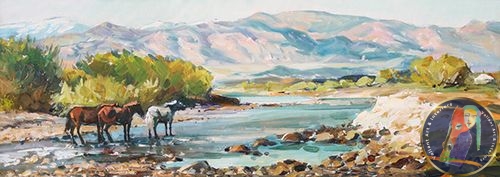
Nature 3 is a panoramic landscape that exemplifies Tsogzol Purev’s mastery of Realism and his deep-seated connection to the Mongolian wilderness. Painted in 2008, during the later years of his prolific career, the work reflects the refined technique of an artist trained both in the rigorous academic traditions of Ulaanbaatar and the cinematic grandeur of the Federal Movie Art Institute in Moscow.

Composition and Visual Narrative

The painting utilizes an elongated cinematic aspect ratio (26 x 70 cm), a choice likely influenced by Purev’s thirty-year tenure as a general art painter for Mongol Kino. This wide format allows the viewer’s eye to travel across the vastness of the Mongolian terrain, mimicking the sweeping pans of a film camera.

  • The Horizon: The composition is characterized by a low horizon line, granting dominance to the expansive sky. This creates a sense of monumental scale, making the land feel eternal and untamed.

  • Atmospheric Perspective: Purev employs a sophisticated use of atmospheric perspective. The foreground is rendered with tactile brushwork, capturing the rugged textures of the earth, while the distant mountains dissolve into soft, hazy blues and purples, suggesting immense physical distance.

  • Color Palette: Staying true to his Realistic roots, the palette is grounded in earthy ochres, deep siennas, and the cool, crystalline blues typical of high-altitude landscapes. The light in the painting feels “lived-in”—it is not the theatrical light of a studio, but the honest, filtered sun of the Dornod region.

Style and Technique

Despite being an oil painting, there is a fluidity in the work that mirrors Purev’s experience in movie art design. Every element is placed with an eye for scenography—the landscape is not just a still life of nature, but a “set” where the wind and light are the primary actors.

The brushwork balances meticulous detail with broader, more impressionistic strokes in the sky and clouds, creating a rhythm that feels both grounded and ethereal. It is a quiet, contemplative piece that shuns abstraction in favor of a truthful representation of the Mongolian “Motherland.”
  • Tsogzol Purev
  • Abstract, Nature
  • Oil On Canvas
  • TSO/006
  • 26 x 70 cm
  • Mongolian Art Gallery

Add Your Comment

Mongolian Art Gallery © 2025. All Rights Reserved
Privacy Policy / Terms of Use

Nature 3 is a panoramic landscape that exemplifies Tsogzol Purev’s mastery of Realism and his deep-seated connection to the Mongolian wilderness. Painted in 2008, during the later years of his prolific career, the work reflects the refined technique of an artist trained both in the rigorous academic traditions of Ulaanbaatar and the cinematic grandeur of the Federal Movie Art Institute in Moscow.

Composition and Visual Narrative

The painting utilizes an elongated cinematic aspect ratio (26 x 70 cm), a choice likely influenced by Purev’s thirty-year tenure as a general art painter for Mongol Kino. This wide format allows the viewer’s eye to travel across the vastness of the Mongolian terrain, mimicking the sweeping pans of a film camera.

  • The Horizon: The composition is characterized by a low horizon line, granting dominance to the expansive sky. This creates a sense of monumental scale, making the land feel eternal and untamed.

  • Atmospheric Perspective: Purev employs a sophisticated use of atmospheric perspective. The foreground is rendered with tactile brushwork, capturing the rugged textures of the earth, while the distant mountains dissolve into soft, hazy blues and purples, suggesting immense physical distance.

  • Color Palette: Staying true to his Realistic roots, the palette is grounded in earthy ochres, deep siennas, and the cool, crystalline blues typical of high-altitude landscapes. The light in the painting feels “lived-in”—it is not the theatrical light of a studio, but the honest, filtered sun of the Dornod region.

Style and Technique

Despite being an oil painting, there is a fluidity in the work that mirrors Purev’s experience in movie art design. Every element is placed with an eye for scenography—the landscape is not just a still life of nature, but a “set” where the wind and light are the primary actors.

The brushwork balances meticulous detail with broader, more impressionistic strokes in the sky and clouds, creating a rhythm that feels both grounded and ethereal. It is a quiet, contemplative piece that shuns abstraction in favor of a truthful representation of the Mongolian “Motherland.”