
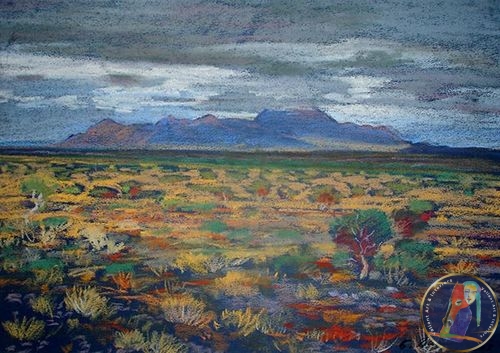
Nature 29 is a masterful testament to Tumurbaatar Badarch’s deep-seated connection to the Mongolian landscape. Created in 2006, this pastel-on-paper work measures 30 x 40 cm, a scale that invites the viewer into an intimate, focused contemplation of the natural world.
Visual Composition and Style
Executed in a style that blends Realism with a soft, atmospheric touch, the painting captures the raw, quiet dignity of the Mongolian countryside. Badarch utilizes the unique properties of pastel—its velvety texture and ability to blend seamlessly—to render the subtle shifts in light and shadow that define a vast horizon.
Color Palette: The artist typically employs a grounded, earthy palette. Expect a harmony of ochres, muted greens, and soft ambers, punctuated by the cool blues or hazy greys of an expansive sky.
Textural Depth: Unlike the sharp edges of oil, the pastel medium allows Badarch to create a “soft focus” effect, mimicking the way distance and wind soften the appearance of the steppe. The paper’s grain likely interacts with the pigment to suggest the ruggedness of dry grass or the jagged surfaces of distant hills.
Perspective: True to the Mongolian landscape tradition, Nature 29 emphasizes the horizontality of the terrain. The composition likely features a low horizon line, giving precedence to the immense sky—a central element in Mongolian spirituality and artistic identity.
Artistic Context
Born in Ulaanbaatar and trained in both Mongolia and the prestigious Mukhin Institute in St. Petersburg, Badarch bridges the gap between classical Russian academic rigor and nomadic sensibilities.
In Nature 29, this background is evident in the precise anatomical understanding of landforms. There is no clutter; the painting is a study of stillness. Following his involvement with the “Oron Zai” (Space) art association, Badarch’s work often explores the philosophical concept of “space” not just as a physical area, but as a living entity.