

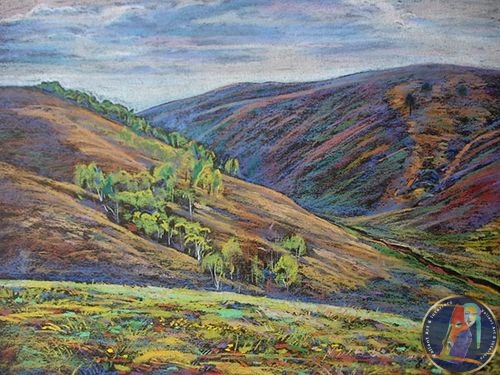
Nature 26 is a serene exploration of the Mongolian wilderness, captured in 2006 by the master realist Tumurbaatar Badarch. Measuring 30 x 40cm, this intimate work utilizes the soft, tactile medium of pastel on paper to translate the rugged beauty of the Central Asian landscape into a delicate atmospheric study.
Visual Composition and Style
Reflecting Badarch’s formal training at the Mukhin Institute in St. Petersburg, the painting is rooted in Academic Realism but infused with a poetic sensitivity toward light and texture.
The Foreground: The artist likely focuses on the subtle transitions of the Mongolian steppe or mountain foothills. Given the medium of pastel, the textures of dry grasses, moss-covered rocks, or low-lying shrubs are rendered with soft, feathered strokes that emphasize the “touch” of the environment.
The Midground: Typical of Badarch’s “Nature” series, there is often a focal point of geological interest—perhaps the jagged edge of a granite outcrop or a quiet cluster of larch trees. The artist uses the blending capability of pastels to create a sense of depth, allowing shapes to recede naturally into the distance.
Atmosphere and Color Palette: The palette is grounded in earth tones—ochre, burnt sienna, and muted sage greens—interspersed with the cool blues and pale violets characteristic of high-altitude light. The use of pastel allows for a “velvety” finish, softening the harsh edges of the landscape to suggest a moment of quietude, likely during the golden hour or a hazy afternoon.
Artistic Context
Created during a mature period of his career, Nature 26 represents Badarch’s lifelong dedication to the “Oron Zai” (Space) art association’s philosophy, which seeks to harmonize traditional Mongolian perceptions of space with modern technical mastery.
The work bridges the gap between the rigid structuralism of his Russian education and the fluid, spiritual connection to the land inherent in his Mongolian heritage. It is not merely a topographical record, but a sensory impression of the vastness and silence of the East Asian landscape.