
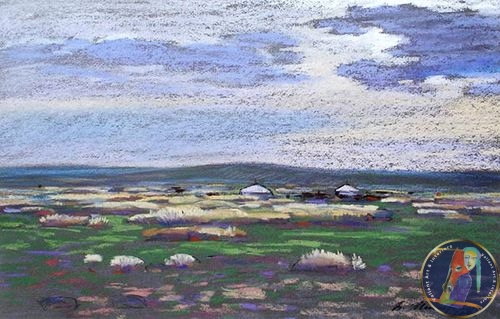
Nature 22

Tumurbaatar Badarch , 2006 , Pastel On Paper

In Nature 22, Tumurbaatar Badarch leverages his mastery of the pastel medium to capture a serene, intimate fragment of the Mongolian landscape. Given the artist’s background in the Realist tradition and his education at the Mukhin Institute in St. Petersburg, the work is defined by a sophisticated balance of light, atmospheric depth, and tactile texture.

  • Composition and Light: The painting likely focuses on a specific topographical feature—perhaps a undulating hillside or a quiet grove—rendered with the soft, velvet-like finish characteristic of high-quality pastel. Badarch often utilizes a “low-sun” lighting scheme that emphasizes the contours of the land, casting long, gentle shadows that give the 30 x 40 cm surface a sense of expansive scale despite its modest physical size.

  • Color Palette: Expect a harmonious blend of earthy ochres, muted greens, and the brilliant, clear blues typical of the “Land of the Eternal Blue Sky.” The artist’s Russian academic training is evident in the nuanced color transitions; he doesn’t just use green for grass, but incorporates flecks of violet, grey, and burnt sienna to simulate the natural weathering of the steppe.

  • Texture and Technique: Unlike the sharp edges of oil, the pastel on paper allows Badarch to blur the horizon line, creating a “sfumato” effect that mimics the hazy distance of the Mongolian wilderness. The strokes are likely directional, following the natural flow of the terrain or the sway of dry grass, providing a rhythmic, almost meditative quality to the piece.

Artistic Context

Created in 2006, this work represents a mature period for Badarch. Following decades of international exhibitions—from Italy to Hong Kong—Nature 22 reflects a shift away from grand historical narratives toward a quiet, profound appreciation for the environmental purity of his homeland. It is a quintessential example of Mongolian Realism: a style that is technically rigorous yet emotionally resonant, capturing a landscape that feels both timeless and fleeting.
  • Tumurbaatar Badarch
  • Nature
  • Pastel On Paper
  • TUM67/052
  • 30 x 40cm
  • Mongolian Art Gallery

Add Your Comment

Mongolian Art Gallery © 2025. All Rights Reserved
Privacy Policy / Terms of Use

In Nature 22, Tumurbaatar Badarch leverages his mastery of the pastel medium to capture a serene, intimate fragment of the Mongolian landscape. Given the artist’s background in the Realist tradition and his education at the Mukhin Institute in St. Petersburg, the work is defined by a sophisticated balance of light, atmospheric depth, and tactile texture.

  • Composition and Light: The painting likely focuses on a specific topographical feature—perhaps a undulating hillside or a quiet grove—rendered with the soft, velvet-like finish characteristic of high-quality pastel. Badarch often utilizes a “low-sun” lighting scheme that emphasizes the contours of the land, casting long, gentle shadows that give the 30 x 40 cm surface a sense of expansive scale despite its modest physical size.

  • Color Palette: Expect a harmonious blend of earthy ochres, muted greens, and the brilliant, clear blues typical of the “Land of the Eternal Blue Sky.” The artist’s Russian academic training is evident in the nuanced color transitions; he doesn’t just use green for grass, but incorporates flecks of violet, grey, and burnt sienna to simulate the natural weathering of the steppe.

  • Texture and Technique: Unlike the sharp edges of oil, the pastel on paper allows Badarch to blur the horizon line, creating a “sfumato” effect that mimics the hazy distance of the Mongolian wilderness. The strokes are likely directional, following the natural flow of the terrain or the sway of dry grass, providing a rhythmic, almost meditative quality to the piece.

Artistic Context

Created in 2006, this work represents a mature period for Badarch. Following decades of international exhibitions—from Italy to Hong Kong—Nature 22 reflects a shift away from grand historical narratives toward a quiet, profound appreciation for the environmental purity of his homeland. It is a quintessential example of Mongolian Realism: a style that is technically rigorous yet emotionally resonant, capturing a landscape that feels both timeless and fleeting.