
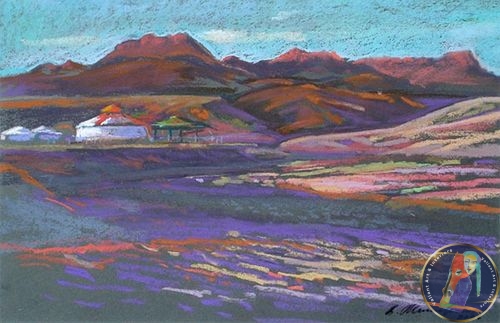
Nature 19 is a masterful testament to Tumurbaatar Badarch’s roots in the Russian academic tradition and his profound connection to the Mongolian landscape. Executed in pastel on paper, the work leverages the soft, tactile quality of the medium to capture the atmospheric nuances of the Central Asian wilderness.
Composition and Visual Narrative
The painting is a focused study of light and texture within a natural setting. Adhering to the principles of Realism, Badarch avoids romanticized abstraction, opting instead for a gritty, honest portrayal of the earth.
Foreground: The lower third of the 30 x 40cm frame is dominated by the intricate detailing of the ground. Using short, decisive strokes of pastel, the artist renders a mixture of arid soil, hardy mountain grasses, and scattered stones.
Midground: The focal point typically involves the transition of terrain—perhaps a gentle slope or the edge of a steppe—where the vegetation becomes more dense. The use of layering in the pastel allows for a rich depth of color, transitioning from sun-bleached ochres to deep, cool shadows.
Atmosphere: There is a palpable sense of stillness. Badarch’s education at the Mukhin Institute in St. Petersburg is evident in his sophisticated control of “Plein Air” lighting; the light feels filtered, suggesting either the sharp clarity of high-altitude morning or the soft, fading glow of evening.