
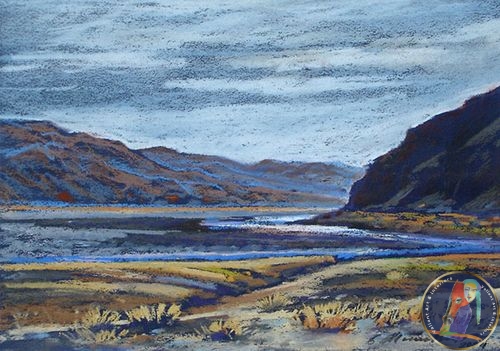
In “Nature 14,” Tumurbaatar Badarch utilizes his rigorous academic training from the Mukhin Institute in St. Petersburg to present a masterclass in Realism filtered through a soft, atmospheric lens. Created in 2006, this piece captures the quietude of the Mongolian landscape, a central theme in Badarch’s body of work.
The use of pastel on paper allows for a velvety texture that mirrors the organic softness of the natural world. Unlike the sharp edges often found in oil landscapes, the pastel medium here creates a seamless transition between light and shadow, evoking a sense of early morning mist or the waning light of dusk.
Key Elements
Atmospheric Depth: Badarch employs a sophisticated use of aerial perspective. The foreground is rendered with tactile precision—likely highlighting the rugged flora of the Mongolian steppe—while the background recedes into hazy, tonal gradients of blue and grey.
Color Palette: True to his Realist roots, the palette is grounded in earth tones. Expect a harmony of ochres, deep greens, and muted browns, punctuated by the soft, diffused light characteristic of high-altitude plains.
Technical Execution: There is a rhythmic quality to the strokes. Badarch uses the side of the pastel for broad color masses (the sky and distant hills) and the tip for fine-line details, such as the skeletal structure of shrubs or the specific contour of a rock formation.
Artistic Context
“Nature 14” represents a mature period in Badarch’s career, following decades of international exhibitions across Italy, Korea, and France. The small scale ($30 \times 40\text{ cm}$) lends the painting an intimate, sketchbook-like quality, suggesting a direct, emotional observation of the land rather than a stylized studio reconstruction.
The piece reflects the “Oron Zai” (Space) art association philosophy, which Badarch has been involved with since 1992—focusing on the profound connection between the Mongolian identity and the vast, uncluttered expanse of its geography. It is less a documentation of a specific place and more a portrait of the silence and permanence of nature.