Nature 12

Tumurbaatar Badarch , 2006 , Pastel On Paper

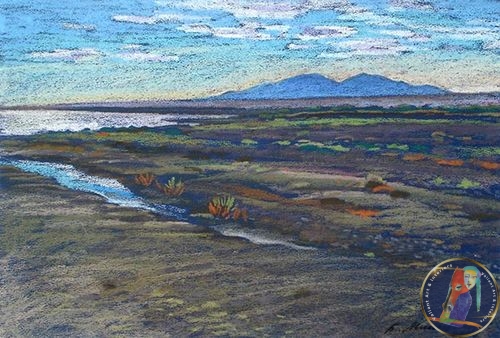
Nature 12 is a serene exploration of the Mongolian landscape, rendered in the soft, tactile medium of pastel on paper. Created in 2006, this 30 x 40cm piece exemplifies Tumurbaatar Badarch’s ability to bridge the gap between rigorous academic realism and the ethereal, atmospheric beauty of the natural world.

Visual Composition and Style

The painting captures a quiet, intimate moment within a vast environment. Eschewing the grand, sweeping vistas often associated with Mongolian steppe art, Badarch focuses on the subtle interplay of light and texture.

  • Atmospheric Realism: Utilizing the smudgeable quality of pastels, the artist creates a hazy, soft-focus effect that mimics the natural humidity or dust of the Mongolian plains. This gives the work a dreamlike quality while maintaining structural accuracy.

  • Palette: The colors are likely muted and earthy, dominated by the ochres, sages, and pale blues characteristic of the high-altitude Mongolian climate. The use of pastel allows for delicate color gradations that suggest the fleeting light of dawn or dusk.

  • Texture: The grain of the paper interacts with the pigment to create a “velvet” finish. Fine lines define the skeletons of hardy shrubs or the ripples of distant hills, while broader strokes suggest the softness of the sky.


About the Artist: Tumurbaatar Badarch

Born in 1958 in Ulaanbaatar, Badarch is a pivotal figure in contemporary Mongolian realism. His technical foundation is exceptionally deep, rooted in both Mongolian tradition and the prestigious European academic style.

Educational Pedigree

  • College of Fine Art, Ulaanbaatar (1978): Where he mastered the foundational aesthetics of Mongolian landscape art.

  • Mukhin Institute of Industrial Art, St. Petersburg (1985): His time in Russia introduced him to the rigorous techniques of Russian Realism, which is evident in the sophisticated spatial depth and lighting of his work.

Artistic Legacy As a member of the “Oron Zai” (Space) art association, Badarch has been instrumental in modernizing Mongolian art while preserving its soul. His work has traveled globally—from the galleries of Italy and France to major exhibitions in Korea and Hong Kong—serving as a cultural bridge that translates the quiet dignity of the Mongolian wilderness for an international audience.
  • Tumurbaatar Badarch
  • Nature, Photorealism
  • Pastel On Paper
  • TUM67/032
  • 30 x 40cm
  • Mongolian Art Gallery

Add Your Comment

Mongolian Art Gallery © 2025. All Rights Reserved
Privacy Policy / Terms of Use

Nature 12 is a serene exploration of the Mongolian landscape, rendered in the soft, tactile medium of pastel on paper. Created in 2006, this 30 x 40cm piece exemplifies Tumurbaatar Badarch’s ability to bridge the gap between rigorous academic realism and the ethereal, atmospheric beauty of the natural world.

Visual Composition and Style

The painting captures a quiet, intimate moment within a vast environment. Eschewing the grand, sweeping vistas often associated with Mongolian steppe art, Badarch focuses on the subtle interplay of light and texture.

  • Atmospheric Realism: Utilizing the smudgeable quality of pastels, the artist creates a hazy, soft-focus effect that mimics the natural humidity or dust of the Mongolian plains. This gives the work a dreamlike quality while maintaining structural accuracy.

  • Palette: The colors are likely muted and earthy, dominated by the ochres, sages, and pale blues characteristic of the high-altitude Mongolian climate. The use of pastel allows for delicate color gradations that suggest the fleeting light of dawn or dusk.

  • Texture: The grain of the paper interacts with the pigment to create a “velvet” finish. Fine lines define the skeletons of hardy shrubs or the ripples of distant hills, while broader strokes suggest the softness of the sky.


About the Artist: Tumurbaatar Badarch

Born in 1958 in Ulaanbaatar, Badarch is a pivotal figure in contemporary Mongolian realism. His technical foundation is exceptionally deep, rooted in both Mongolian tradition and the prestigious European academic style.

Educational Pedigree

  • College of Fine Art, Ulaanbaatar (1978): Where he mastered the foundational aesthetics of Mongolian landscape art.

  • Mukhin Institute of Industrial Art, St. Petersburg (1985): His time in Russia introduced him to the rigorous techniques of Russian Realism, which is evident in the sophisticated spatial depth and lighting of his work.

Artistic Legacy As a member of the “Oron Zai” (Space) art association, Badarch has been instrumental in modernizing Mongolian art while preserving its soul. His work has traveled globally—from the galleries of Italy and France to major exhibitions in Korea and Hong Kong—serving as a cultural bridge that translates the quiet dignity of the Mongolian wilderness for an international audience.