

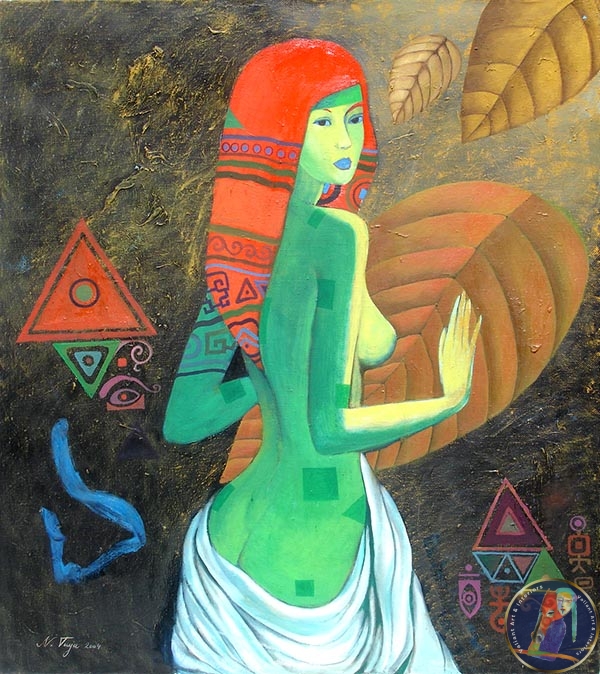
Namar (the Mongolian word for “Autumn”) is a evocative oil painting that beautifully bridges the artist’s rich Mongolian heritage with global modern art influences. The composition utilizes its 90 x 80 cm canvas to capture a transitional, reflective atmosphere, blending elements of traditional nomadic life with abstract, fluid forms.
At the center of the piece is a stylized, poetic interpretation of the Mongolian landscape during the autumn season. Rather than a strictly realist depiction, Natsagdorj employs a semi-abstract, almost dreamlike approach. The canvas is filled with sweeping, organic lines that suggest the rolling steppes, shifting winds, and the architectural curves of traditional gers (yurts). Figures or livestock may appear as minimalist, elongated silhouettes integrated harmoniously into the terrain, underscoring the deep, symbiotic relationship between the land and its inhabitants.
Color Palette and Light
True to its title, the color palette is a rich, warm exploration of autumn tones, heavily informed by the distinct light of the Mongolian plateau and refined by the artist’s global studies.
Dominant Tones: Deep ochres, burnt sienna, and golden ambers dominate the canvas, capturing the drying grasses of the steppe.
Accents: These warm tones are juxtaposed against cool slate blues, muted greens, and sudden, vibrant streaks of crimson or stark white, creating a sense of crisp, changing air.
The light in the painting is non-directional and atmospheric. It feels diffused, as if filtering through an overcast autumn sky, casting a nostalgic, contemplative glow across the entire composition.
Technique and Texture
Natsagdorj’s diverse educational background—spanning fine arts in Ulaanbaatar, scenic paint training in Kyiv, and traditional sensibilities in Kyoto—manifests in the painting’s sophisticated texture.
The oil paint is applied with a dynamic mix of techniques. In some areas, thin, translucent washes create a sense of vast, open space and atmospheric depth, reminiscent of East Asian ink traditions. In other sections, the artist uses a palette knife and thick, impasto brushstrokes to build physical texture, giving the canvas a tactile quality that mirrors the rugged, raw beauty of the Mongolian earth. The brushwork is deliberate yet fluid, lending a theatrical, scenic movement to the piece that hints at her background in stage painting.
Mood and Interpretation
The overall mood of Namar is one of quiet introspection, poetic melancholy, and profound warmth. It captures the essence of a season defined by preparation, harvest, and the quiet beauty of nature slowing down. The painting stands as a testament to Natsagdorj’s signature style as a freelance contemporary artist: a seamless blend of nomadic soul, European structural execution, and a minimalist aesthetic.
