
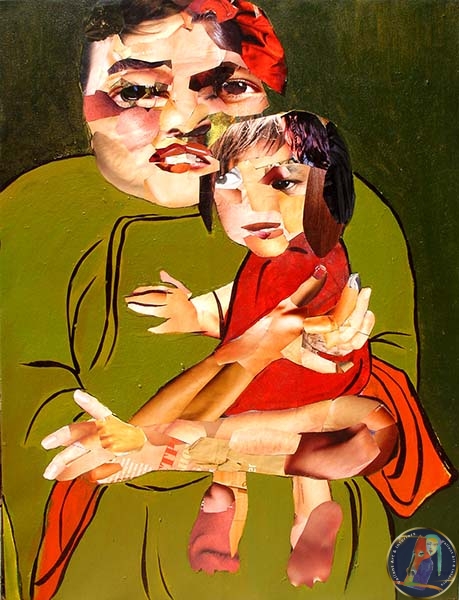
Mother With Baby I is a poignant exploration of maternal bond, rendered through a sophisticated blend of minimalism and geometric abstraction. Created during the final year of Nandin-erdene Budzagd’s Master’s studies at the University of Arts and Culture in Ulaanbaatar, the work reflects a transition from traditional Mongolian figurative roots toward a modern, universal visual language.
Composition and Style
The painting utilizes a vertical 80 x 60 cm format to create an intimate, focused space. Budzagd employs a minimalist approach, stripping away environmental clutter to center the viewer’s attention entirely on the two figures.
The Figures: The mother and child are not depicted with anatomical realism but are instead reimagined through geometric simplification. The artist uses clean lines and intersecting planes to suggest the curvature of a protective embrace. The “Figurative-Abstract” style allows the viewer to recognize the emotional weight of the subjects without relying on facial expressions.
Mixed Media Textures: The use of mixed media adds a tactile dimension to the canvas. Subtle layering creates a weathered or “lived-in” surface, perhaps echoing the ancient textures of the Mongolian landscape or traditional textiles, juxtaposed against sharp, contemporary structural lines.
Color and Form
True to the Geometric style associated with Budzagd, the forms are broken down into essential shapes—circles and arcs representing the heads and the enclosing arms, while elongated rectangles or triangles suggest the torso.
Palette: The color scheme is likely restrained, using tonal shifts to create depth rather than vibrant, distracting hues. This reinforces the “Minimalist” label, emphasizing the serenity and gravity of the relationship.
Balance: There is a profound sense of equilibrium in the work. The “Mother” figure acts as a foundational anchor, while the “Baby” is integrated into her form, suggesting a singular, unified entity rather than two separate bodies.
Conceptual Meaning
In Mother With Baby I, Budzagd transcends specific cultural markers to touch on the universal theme of nurture. By applying Abstract principles to such a primal human subject, the artist elevates the mundane act of holding a child into a timeless, iconic symbol. The 2006 piece stands as a testament to the artist’s formal education in Ulaanbaatar, showcasing a masterful command over how space and geometry can convey deep human emotion.