
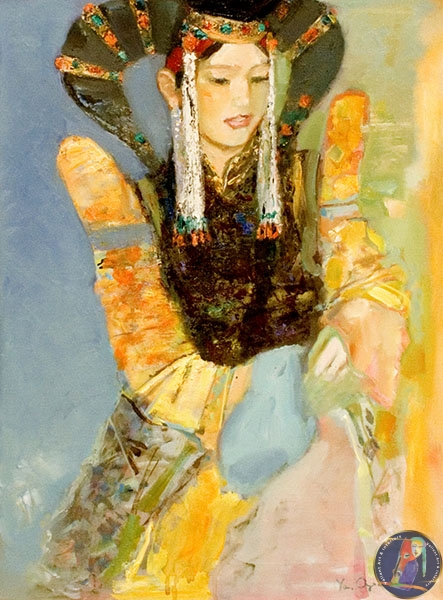
Mongolian Queen3

Oyunchimeg Yadamsuren , 2007 , Oil On Canvas

Mongolian Queen III is a striking portrait that blends the rigorous technical training of the Russian academic tradition with the vibrant, symbolic heritage of Mongolian aesthetics. The composition focuses on a central female figure, rendered with a regal and serene composure that commands the viewer’s attention.

Subject and Composition The “Queen” is depicted in a formal, near-frontal pose, emphasizing symmetry and balance. Her facial features are rendered with soft, realistic modeling—a nod to Yadamsuren’s education at the Repin Academy—giving her a lifelike presence that feels both timeless and contemporary. Her gaze is steady and dignified, embodying a sense of quiet power and cultural pride.

Attire and Ornamentation The painting is a masterclass in the depiction of texture and traditional Mongolian finery. The queen wears an elaborate deel (traditional robe) and a highly detailed headdress, which serves as the focal point of the piece.

  • The Headdress: Intricately painted to suggest precious materials such as silver, coral, and turquoise, the headdress features the iconic “winged” or “horned” silhouettes historically associated with Khalkha Mongol nobility.

  • Jewelry: Strands of pearls and filigree ornaments drape alongside her face, captured with precise brushwork that highlights the play of light on metallic surfaces.

Color Palette and Technique The artist utilizes a rich, harmonious color palette. Deep jewel tones in the clothing contrast with the warmer, natural skin tones of the subject. The background is often treated with more fluid, atmospheric brushstrokes, ensuring that the sharp detail of the queen’s regalia remains the primary visual interest. The oil medium is used to build depth, particularly in the heavy fabrics and the luster of the traditional jewelry.


Artistic Context

Created by one of Mongolia’s prominent contemporary artists, this work represents the synthesis of two worlds. While the form and anatomical precision reflect her years in St. Petersburg, the soul of the painting is rooted in the “Mongol Zurag” tradition—a style dedicated to preserving the unique identity, history, and majestic beauty of Mongolian heritage.
  • Oyunchimeg Yadamsuren
  • Sukhbaatar, Mongolia
  • Nature, Portrait, Realism, Still Life
  • Oil on canvas
  • OYU45/008
  • 70 x 50cm27" x 19"
  • Valiant Art & Interiors

Add Your Comment

Mongolian Art Gallery © 2025. All Rights Reserved
Privacy Policy / Terms of Use

Mongolian Queen III is a striking portrait that blends the rigorous technical training of the Russian academic tradition with the vibrant, symbolic heritage of Mongolian aesthetics. The composition focuses on a central female figure, rendered with a regal and serene composure that commands the viewer’s attention.

Subject and Composition The “Queen” is depicted in a formal, near-frontal pose, emphasizing symmetry and balance. Her facial features are rendered with soft, realistic modeling—a nod to Yadamsuren’s education at the Repin Academy—giving her a lifelike presence that feels both timeless and contemporary. Her gaze is steady and dignified, embodying a sense of quiet power and cultural pride.

Attire and Ornamentation The painting is a masterclass in the depiction of texture and traditional Mongolian finery. The queen wears an elaborate deel (traditional robe) and a highly detailed headdress, which serves as the focal point of the piece.

  • The Headdress: Intricately painted to suggest precious materials such as silver, coral, and turquoise, the headdress features the iconic “winged” or “horned” silhouettes historically associated with Khalkha Mongol nobility.

  • Jewelry: Strands of pearls and filigree ornaments drape alongside her face, captured with precise brushwork that highlights the play of light on metallic surfaces.

Color Palette and Technique The artist utilizes a rich, harmonious color palette. Deep jewel tones in the clothing contrast with the warmer, natural skin tones of the subject. The background is often treated with more fluid, atmospheric brushstrokes, ensuring that the sharp detail of the queen’s regalia remains the primary visual interest. The oil medium is used to build depth, particularly in the heavy fabrics and the luster of the traditional jewelry.


Artistic Context

Created by one of Mongolia’s prominent contemporary artists, this work represents the synthesis of two worlds. While the form and anatomical precision reflect her years in St. Petersburg, the soul of the painting is rooted in the “Mongol Zurag” tradition—a style dedicated to preserving the unique identity, history, and majestic beauty of Mongolian heritage.