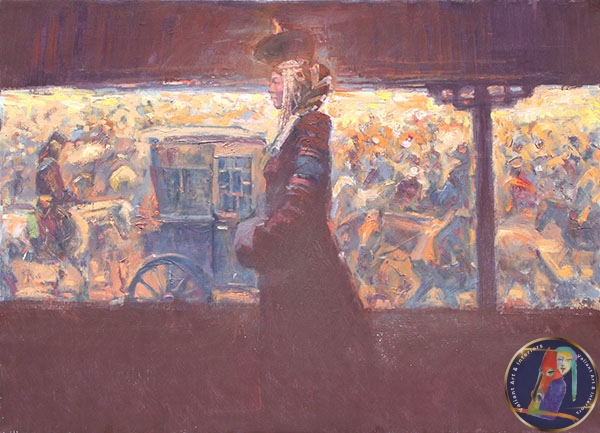
Mongolian Queen 9

Usukhbayar Zagd , 2008 , Oil On Canvas

Mongolian Queen 9 is an evocative portrait that bridges traditional nomadic iconography with semi-abstract modernism. The composition focuses heavily on a stylized interpretation of a historical Mongolian noblewoman (Khatun), capturing both the literal grandeur of historic court regalia and an ethereal, internal psychology.

The queen is positioned centrally or slightly off-center within a tight frame, drawing the viewer’s immediate attention to her face and her highly ornate, structured headdress. Rather than aiming for absolute realism, Zagd utilizes a fluid, expressive approach where sharp structural lines of costume melt into softer, atmospheric brushwork.

Color Palette and Texture

  • Dominant Tones: The piece relies on a sophisticated juxtaposition of deep, earthy tones—reminiscent of the Mongolian steppe—intertwined with jewel-toned accents typically found in silk brocades and royal garments (such as deep blues, rich crimsons, or muted golds).

  • Texture: Layered applications of oil paint give the canvas a highly tactile quality. In some areas, the paint is applied smoothly to emphasize the grace of the figure’s features; in others, visible, broken brushstrokes and textured scumbling evoke the weathered nature of old tapestries, historic artifacts, and the passing of time.

Garments and Regalia

Central to the visual narrative is the depiction of the traditional Mongolian headdress, heavily inspired by the historic Khalkha bridal and royal attire.

  • Structure: The headdress features wide, wing-like projections extending horizontally and curving downward, mimicking the horns of a mythical creature or a bighorn sheep—a traditional symbol of grace, power, and high status.

  • Ornamentation: Zagd uses abstract dabs and metallic-hued glazes of oil paint to imply the presence of elaborate silver filigree, coral beads, and turquoise inlays cascading down the sides of the face in decorative tresses (shiveleg).

  • Attire: The collar of her deel (traditional tunic robe) rises high against her neck, structural and proud, anchoring the portrait with a sense of regal authority and timelessness.

Mood and Atmosphere

The lighting in the painting is dramatic and directional, casting subtle shadows across the subject’s face to emphasize her contemplative, solemn expression. There is a profound stillness to her gaze. Through his training in post-Soviet Ukraine and his roots in Ulaanbaatar, Zagd infuses the piece with a distinct “Ego Art” sensibility—focusing heavily on individual consciousness. The queen is not merely a historical relic; she is presented as a psychological entity, embodying resilience, quiet dignity, and the lingering spirit of Mongolia’s ancestral past.

Artist Biography & Chronology

Background & Education

Born in the capital city of Ulaanbaatar in 1964, Usukhbayar Zagd belongs to a pivotal generation of Mongolian artists who came of age during a period of massive political and cultural transition. His formal training reflects a blend of classical foundation and international avant-garde exposure:

  • 1984: Graduated from the College of Fine Art, Ulaanbaatar, where he mastered foundational rendering and classical Mongolian motifs.

  • 1992: Graduated from the prestigious Institute of Industrial Art in Kharkiv, Ukraine, exposing him to European modernism, expressionism, and Western contemporary design theory.

Selected Exhibition History

Zagd’s career took off rapidly following his return from Ukraine, marked by early participation in influential artist collectives and international solo tours:

  • 1989: Participated in the seminal “Search” joint exhibition in Ulaanbaatar, pushing boundaries of traditional themes.

  • 1992: Launched international solo exhibitions with the Ego Art group, showcasing his works in private galleries across Berlin, Germany and Amsterdam, Netherlands.

  • 1995: Held the solo exhibition “Station” at the Hotel White House, Ulaanbaatar.

  • 1996: Returned to Western Europe for a solo exhibition in a private gallery in Berlin.

  • 1990–1997: Consistently featured as a core contemporary voice in the annual Spring and Autumn joint exhibitions in Ulaanbaatar.
  • Usukhbayar Zagd
  • Ulaanbaatar, Mongolia
  • Figurative, Landscape, Portrait, Realism
  • Oil on canvas
  • USU75/009
  • 50 x 70cm19" x 27"
  • Valiant Art & Interiors

Add Your Comment

Mongolian Art Gallery © 2025. All Rights Reserved
Privacy Policy / Terms of Use

Mongolian Queen 9 is an evocative portrait that bridges traditional nomadic iconography with semi-abstract modernism. The composition focuses heavily on a stylized interpretation of a historical Mongolian noblewoman (Khatun), capturing both the literal grandeur of historic court regalia and an ethereal, internal psychology.

The queen is positioned centrally or slightly off-center within a tight frame, drawing the viewer’s immediate attention to her face and her highly ornate, structured headdress. Rather than aiming for absolute realism, Zagd utilizes a fluid, expressive approach where sharp structural lines of costume melt into softer, atmospheric brushwork.

Color Palette and Texture

  • Dominant Tones: The piece relies on a sophisticated juxtaposition of deep, earthy tones—reminiscent of the Mongolian steppe—intertwined with jewel-toned accents typically found in silk brocades and royal garments (such as deep blues, rich crimsons, or muted golds).

  • Texture: Layered applications of oil paint give the canvas a highly tactile quality. In some areas, the paint is applied smoothly to emphasize the grace of the figure’s features; in others, visible, broken brushstrokes and textured scumbling evoke the weathered nature of old tapestries, historic artifacts, and the passing of time.

Garments and Regalia

Central to the visual narrative is the depiction of the traditional Mongolian headdress, heavily inspired by the historic Khalkha bridal and royal attire.

  • Structure: The headdress features wide, wing-like projections extending horizontally and curving downward, mimicking the horns of a mythical creature or a bighorn sheep—a traditional symbol of grace, power, and high status.

  • Ornamentation: Zagd uses abstract dabs and metallic-hued glazes of oil paint to imply the presence of elaborate silver filigree, coral beads, and turquoise inlays cascading down the sides of the face in decorative tresses (shiveleg).

  • Attire: The collar of her deel (traditional tunic robe) rises high against her neck, structural and proud, anchoring the portrait with a sense of regal authority and timelessness.

Mood and Atmosphere

The lighting in the painting is dramatic and directional, casting subtle shadows across the subject’s face to emphasize her contemplative, solemn expression. There is a profound stillness to her gaze. Through his training in post-Soviet Ukraine and his roots in Ulaanbaatar, Zagd infuses the piece with a distinct “Ego Art” sensibility—focusing heavily on individual consciousness. The queen is not merely a historical relic; she is presented as a psychological entity, embodying resilience, quiet dignity, and the lingering spirit of Mongolia’s ancestral past.

Artist Biography & Chronology

Background & Education

Born in the capital city of Ulaanbaatar in 1964, Usukhbayar Zagd belongs to a pivotal generation of Mongolian artists who came of age during a period of massive political and cultural transition. His formal training reflects a blend of classical foundation and international avant-garde exposure:

  • 1984: Graduated from the College of Fine Art, Ulaanbaatar, where he mastered foundational rendering and classical Mongolian motifs.

  • 1992: Graduated from the prestigious Institute of Industrial Art in Kharkiv, Ukraine, exposing him to European modernism, expressionism, and Western contemporary design theory.

Selected Exhibition History

Zagd’s career took off rapidly following his return from Ukraine, marked by early participation in influential artist collectives and international solo tours:

  • 1989: Participated in the seminal “Search” joint exhibition in Ulaanbaatar, pushing boundaries of traditional themes.

  • 1992: Launched international solo exhibitions with the Ego Art group, showcasing his works in private galleries across Berlin, Germany and Amsterdam, Netherlands.

  • 1995: Held the solo exhibition “Station” at the Hotel White House, Ulaanbaatar.

  • 1996: Returned to Western Europe for a solo exhibition in a private gallery in Berlin.

  • 1990–1997: Consistently featured as a core contemporary voice in the annual Spring and Autumn joint exhibitions in Ulaanbaatar.