
Mongolian Queen 8

Usukhbayar Zagd , 2008 , Oil On Canvas

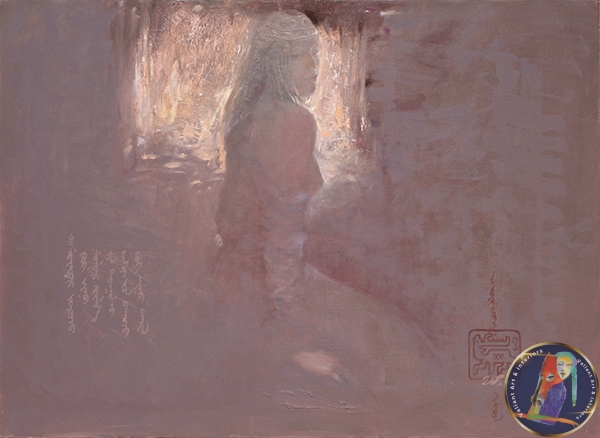
The painting features a central, stylized portrait of a noble Mongolian queen (Khatun), rendered with a striking balance of traditional iconography and late twentieth-century academic precision. Captured from the torso up, she sits in a poised, symmetrical frontal posture that commands immediate authority. Her facial features are smooth and serene, characterized by high cheekbones, almond-shaped eyes gazing calmly forward, and a subtle, enigmatic expression that evokes an air of timeless dignity.

Attire and Headdress

The focus of the composition is her elaborate, highly detailed traditional headdress, which reflects the artist’s training in industrial and decorative arts.

  • The Headdress: The structure rises dramatically, mimicking the sweeping, curved horns of the argali sheep—a classic marker of Khalkha Mongol nobility. It is intricately adorned with silver-toned filigree work, coral-red beads, and deep blue turquoise inlays that catch a soft, directional light. Decorative silver plaques and long, beaded tassels cascade down the sides of her face, framing her jawline and resting elegantly on her shoulders.

  • The Garment: She wears a high-collared deel (traditional tunic) fashioned from rich, heavy fabric. The silk texture is implied through delicate brushwork, featuring subtle geometric patterns or floral roundels woven with faint gold or silver threads. The collar is fastened tightly, emphasizing her straight, regal posture.

Color Palette and Lighting

The color palette is sophisticated, grounded in deep, jewel-toned colors contrasted against warm, earthy undertones.

  • Dominant Tones: Crimson, rich burgundy, and deep blues dominate her attire, accented by the vivid corals and turquoises of her jewelry. Her skin tone is rendered in soft, luminous ivory and warm beige.

  • Lighting: The lighting is soft and focused, as if originating from a single, low-angle source—reminiscent of the light inside a traditional ger. This directional light creates gentle highlights on the metallic elements of her headdress and casts soft shadows that give depth to the folds of her garment and the contours of her face.

Background and Texture

The background is heavily textured and semi-abstract, preventing the portrait from feeling entirely static. Usukhbayar utilizes visible, layered brushstrokes and subtle palette knife work to create a mottled surface.

  • Background Elements: The background blends muted tones of ochre, deep amber, and dark charcoal, suggesting either the dim, smoky interior of a royal tent or a vast, twilight sky over the steppe. The lack of distinct environmental details ensures the viewer’s eye remains locked onto the intricate details of the queen herself.

  • Overall Surface Feel: The oil medium is applied with varying density—smooth and precise on the skin and jewelry, but broader and more expressive in the background, creating a beautiful tactile contrast across the $50 \times 70\text{ cm}$ canvas.
  • Usukhbayar Zagd
  • Ulaanbaatar, Mongolia
  • Figurative, Landscape, Portrait, Realism
  • Oil on canvas
  • USU75/008
  • 50 x 70cm19" x 27"
  • Valiant Art & Interiors

Add Your Comment

Mongolian Art Gallery © 2025. All Rights Reserved
Privacy Policy / Terms of Use

The painting features a central, stylized portrait of a noble Mongolian queen (Khatun), rendered with a striking balance of traditional iconography and late twentieth-century academic precision. Captured from the torso up, she sits in a poised, symmetrical frontal posture that commands immediate authority. Her facial features are smooth and serene, characterized by high cheekbones, almond-shaped eyes gazing calmly forward, and a subtle, enigmatic expression that evokes an air of timeless dignity.

Attire and Headdress

The focus of the composition is her elaborate, highly detailed traditional headdress, which reflects the artist’s training in industrial and decorative arts.

  • The Headdress: The structure rises dramatically, mimicking the sweeping, curved horns of the argali sheep—a classic marker of Khalkha Mongol nobility. It is intricately adorned with silver-toned filigree work, coral-red beads, and deep blue turquoise inlays that catch a soft, directional light. Decorative silver plaques and long, beaded tassels cascade down the sides of her face, framing her jawline and resting elegantly on her shoulders.

  • The Garment: She wears a high-collared deel (traditional tunic) fashioned from rich, heavy fabric. The silk texture is implied through delicate brushwork, featuring subtle geometric patterns or floral roundels woven with faint gold or silver threads. The collar is fastened tightly, emphasizing her straight, regal posture.

Color Palette and Lighting

The color palette is sophisticated, grounded in deep, jewel-toned colors contrasted against warm, earthy undertones.

  • Dominant Tones: Crimson, rich burgundy, and deep blues dominate her attire, accented by the vivid corals and turquoises of her jewelry. Her skin tone is rendered in soft, luminous ivory and warm beige.

  • Lighting: The lighting is soft and focused, as if originating from a single, low-angle source—reminiscent of the light inside a traditional ger. This directional light creates gentle highlights on the metallic elements of her headdress and casts soft shadows that give depth to the folds of her garment and the contours of her face.

Background and Texture

The background is heavily textured and semi-abstract, preventing the portrait from feeling entirely static. Usukhbayar utilizes visible, layered brushstrokes and subtle palette knife work to create a mottled surface.

  • Background Elements: The background blends muted tones of ochre, deep amber, and dark charcoal, suggesting either the dim, smoky interior of a royal tent or a vast, twilight sky over the steppe. The lack of distinct environmental details ensures the viewer’s eye remains locked onto the intricate details of the queen herself.

  • Overall Surface Feel: The oil medium is applied with varying density—smooth and precise on the skin and jewelry, but broader and more expressive in the background, creating a beautiful tactile contrast across the $50 \times 70\text{ cm}$ canvas.