
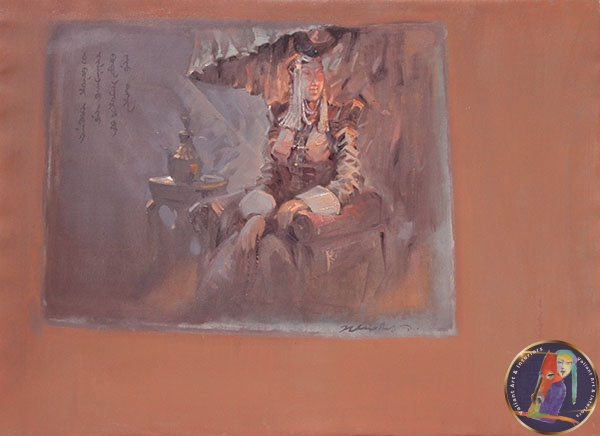
“Mongolian Queen 4” is a vertical oil-on-canvas portrait measuring 50 by 70 cm. The painting presents a striking, highly stylized, and semi-abstracted depiction of a regal Mongolian noblewoman. Bridging traditional nomadic iconography with Western avant-garde influences—reflective of the artist’s training in both Ulaanbaatar and Ukraine—the composition is deeply psychological, trading literal photorealism for a powerful, symbolic representation of historical majesty.
The queen is positioned centrally, viewed from the upper chest upward. The composition relies heavily on strong vertical lines and geometric forms, giving the figure an architectural, almost monumental presence despite the canvas’s moderate dimensions.
Color Palette and Atmosphere
The color scheme is sophisticated, atmospheric, and intentionally restrained, dominated by a dialogue between deep, historic tones and muted neutrals:
The Background: A textured, atmospheric wash of deep charcoal greys, smoky black, and subtle undertones of raw umber. The background lacks physical depth or a defined setting, creating a timeless, void-like space that pushes the subject forward.
The Figure & Garments: The palette shifts to rich, regal tones. Deep crimson, burgundy, and oxidized madder reds define the core of her traditional attire. These are contrasted by passages of earthy ochres, muted golds, and deep indigo blues.
Skin Tones: The queen’s face is rendered not in natural flesh tones, but in a pale, ivory-to-alabaster hue, creating a dramatic, mask-like contrast against both her dark hair and the background.
Detailed Description of Subject Matter
1. Face and Expression
The face is the focal point, stylized with elongated, minimalist features reminiscent of modernist portraiture and traditional Asian mask iconography.
Her eyes are narrow, stylized slits or fine dark lines, conveying a sense of internal calm, calculation, and aristocratic detachment.
The nose is long, straight, and sharp, sculpted with minimal shading.
Her lips are small, painted a precise, deep crimson red, set in a neutral, enigmatic expression.
The skin is impeccably smooth, devoid of texture or aging lines, elevating her from a specific historical person to an eternal archetype of Mongolian royalty.
2. Traditional Headdress and Hair
The artist pays meticulous attention to the silhouette of the traditional Khalkha queen’s headdress, though it is interpreted through a distinct, stylized lens.
The Hair: Her hair is fashioned into the iconic, expansive “cow-horn” shape (shiveger), spanning outward to the edges of the mid-canvas. The dark, sleek masses of hair are rendered with smooth, graphic curves rather than individual strands.
The Headdress (Khantor): Atop her head sits a stylized crown-like cap, adorned with geometric patterns suggesting silver filigree, coral, and turquoise inlay. Rows of intricate, dangling ornaments—representing traditional pearls and silver chains—frame her face, cascading down toward her shoulders. The metallic elements are painted with textured strokes of muted gold and ochre, capturing the dull gleam of antique metal rather than a bright shine.
3. Deel and Attire
From the neck down, the queen wears a high-collared traditional dress (deel).
The collar is stiff and high, hugging her jawline, painted in deep burgundy with a gold-trimmed border.
The shoulders of the garment feature the characteristic high, structured puffs, rendered with bold, sweeping brushstrokes that give her form an armor-like rigidity.
The fabric texture is implied through layered oil glazes, suggesting heavy silk brocade or velvet, with faint, abstracted traditional patterns woven into the darker folds of the paint.
Brushwork, Texture, and Style
Usukhbayar’s technique in this piece relies on a compelling contrast between smooth, graphic precision and expressive, layered textures:
Linear Precision: The outlines of the face, the eyes, and the primary curves of the headdress are executed with fine, deliberate line control, emphasizing form and silhouette.
Layered Textures: In contrast to the smooth face, the background and the lower portions of her garments feature visible brushwork, subtle impasto, and layering. The artist uses a dry-brush technique in areas of the background, letting hints of the under-layer peek through, which imbues the canvas with an antique, weathered quality—as if the image is a fragment of a memory or a fresco recovered from the past.
The overall mood of “Mongolian Queen 4” is one of quiet, imposing dignity. It captures the essence of historical Mongolian majesty through a lens of late-20th-century artistic experimentation, making the subject appear simultaneously ancient and profoundly modern.