
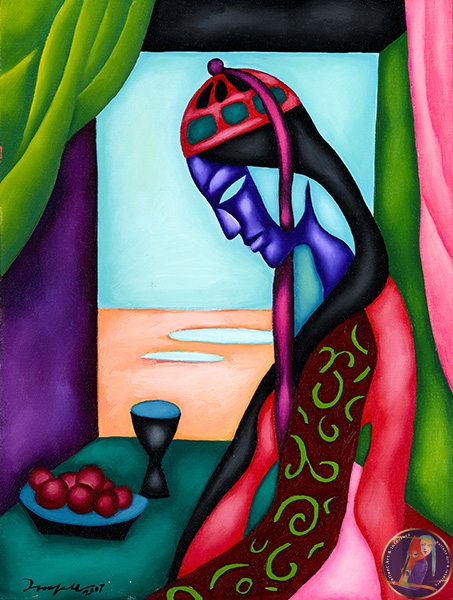
In “Mongolian Queen,” Enkhjargal Tsagaandari blends her background in monumental art and figurative contemporary painting to create a portrait that feels both intimate and statuesque. Despite the modest dimensions of the canvas (40 x 30 cm), the subject is rendered with a sense of grandeur that reflects the artist’s experience with large-scale atelier work.
The painting features a central female figure, depicted with the regal poise characteristic of Mongolian nobility. The style is a sophisticated fusion of modern abstraction and traditional figurative art. Tsagaandari employs a rich, textured application of oil paint, using visible brushstrokes to build a surface that feels tactile and alive.
Color Palette and Symbolism
The artist utilizes a palette that bridges the gap between the earthy tones of the Mongolian landscape and the vibrant colors of silk deels (traditional tunics).
The Subject: The “Queen” is typically adorned in elaborate traditional attire, often featuring high-collared robes and intricate headdresses that signify status. The artist focuses on the geometric shapes of these garments, occasionally veering into abstract patterns to represent embroidery or jewelry.
Lighting and Atmosphere: There is a soft, diffused light that radiates from the figure, a common trait in Tsagaandari’s “Nature” and “Landscape” associated works, suggesting a deep spiritual connection between the sovereign and the land she represents.
Artistic Context
Created in 2007, during Tsagaandari’s prolific period as a freelance artist, this work captures the essence of post-socialist Mongolian contemporary art—a movement defined by reclaiming national identity through a modern lens. The painting moves away from rigid realism, instead favoring an emotive, contemporary aesthetic that emphasizes the inner strength and stoicism of the Mongolian woman.
The composition reflects the artist’s pedagogical history at the College of Fine Art, showcasing a mastery of formal balance while maintaining the “Spring-like” freshness and vitality seen in her early career exhibitions. It is a quiet yet powerful celebration of heritage, rendered with the technical precision of a veteran of the Union of Mongolian Artists.