Mongolian Queen

Khurelbaatar Choindon , 2006 , Oil On Canvas

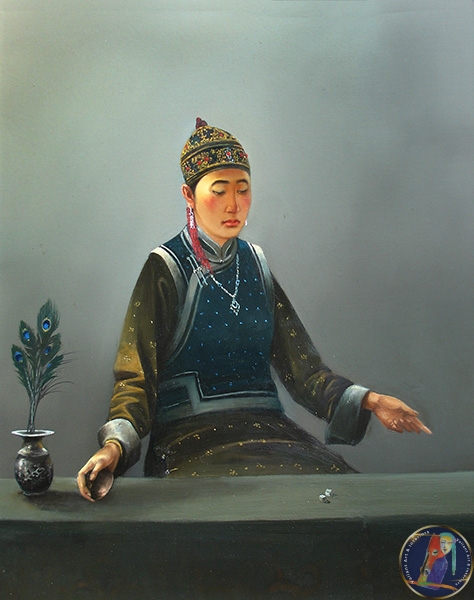
Khurelbaatar Choindon’s Mongolian Queen is a masterful exploration of cultural heritage through the lens of contemporary photorealism. Painted in 2006, this oil-on-canvas work ($61 \times 72$ cm) serves as a bridge between the artist’s rigorous academic training at the Repin Academy in St. Petersburg and his deep-seated Mongolian roots.

Visual Composition and Style

The painting is a prime example of Photorealism blended with Figurative Realism. Choindon focuses intensely on the portrait of a woman adorned in traditional royal Mongolian attire. The composition is intimate, focusing on the upper torso and head, which allows the artist to showcase his technical virtuosity in rendering diverse textures.

  • The Subject: The “Queen” is depicted with a serene, dignified expression. Her features are rendered with such precision that the subtle play of light on her skin suggests a living, breathing presence.

  • Textural Contrast: A hallmark of this piece is the contrast between the soft, matte quality of the skin and the intricate, reflective surfaces of her jewelry and headpiece. Choindon utilizes fine brushwork to capture the sheen of silk, the weight of precious metals, and the specific luster of coral and turquoise stones—materials deeply symbolic in Mongolian nomadic culture.


Cultural Significance

Choindon’s background as the Vice Chairman of the Union of Mongolian Artists (UMA) informs the authoritative way he presents national identity. In Mongolian Queen, the attire is not merely decorative; it is an ethnographic study.

  • The Shivei (Headgear): The painting likely highlights the elaborate khalkha headdress, traditionally shaped like the horns of a mythical beast or a cow, symbolizing fertility and nomadic power.

  • Color Palette: The artist employs a rich, earthy, yet vibrant palette. Deep reds and blues dominate the garment, while the background is often kept minimal or atmospheric to ensure the viewer’s gaze remains fixed on the regal subject.


Artistic Legacy

Reflecting his education at the College of Fine Art in Ulaanbaatar and the Repin Academy, the work demonstrates a “Russian School” influence in its structural integrity and light handling, yet remains uniquely Mongolian in soul.

Mongolian Queen stands as a testament to Choindon’s ability to elevate traditional subjects into the realm of high-fidelity fine art, making it a significant piece in the canon of modern Mongolian realism. Its dimensions make it an intimate window into a bygone era of steppe royalty, preserved through 21st-century technique.
  • Khurelbaatar Choindon
  • Figurative, Realism
  • Oil On Canvas
  • KBR31/039
  • 61 x 72cm
  • Mongolian Art Gallery

Add Your Comment

Mongolian Art Gallery © 2025. All Rights Reserved
Privacy Policy / Terms of Use

Khurelbaatar Choindon’s Mongolian Queen is a masterful exploration of cultural heritage through the lens of contemporary photorealism. Painted in 2006, this oil-on-canvas work ($61 \times 72$ cm) serves as a bridge between the artist’s rigorous academic training at the Repin Academy in St. Petersburg and his deep-seated Mongolian roots.

Visual Composition and Style

The painting is a prime example of Photorealism blended with Figurative Realism. Choindon focuses intensely on the portrait of a woman adorned in traditional royal Mongolian attire. The composition is intimate, focusing on the upper torso and head, which allows the artist to showcase his technical virtuosity in rendering diverse textures.

  • The Subject: The “Queen” is depicted with a serene, dignified expression. Her features are rendered with such precision that the subtle play of light on her skin suggests a living, breathing presence.

  • Textural Contrast: A hallmark of this piece is the contrast between the soft, matte quality of the skin and the intricate, reflective surfaces of her jewelry and headpiece. Choindon utilizes fine brushwork to capture the sheen of silk, the weight of precious metals, and the specific luster of coral and turquoise stones—materials deeply symbolic in Mongolian nomadic culture.


Cultural Significance

Choindon’s background as the Vice Chairman of the Union of Mongolian Artists (UMA) informs the authoritative way he presents national identity. In Mongolian Queen, the attire is not merely decorative; it is an ethnographic study.

  • The Shivei (Headgear): The painting likely highlights the elaborate khalkha headdress, traditionally shaped like the horns of a mythical beast or a cow, symbolizing fertility and nomadic power.

  • Color Palette: The artist employs a rich, earthy, yet vibrant palette. Deep reds and blues dominate the garment, while the background is often kept minimal or atmospheric to ensure the viewer’s gaze remains fixed on the regal subject.


Artistic Legacy

Reflecting his education at the College of Fine Art in Ulaanbaatar and the Repin Academy, the work demonstrates a “Russian School” influence in its structural integrity and light handling, yet remains uniquely Mongolian in soul.

Mongolian Queen stands as a testament to Choindon’s ability to elevate traditional subjects into the realm of high-fidelity fine art, making it a significant piece in the canon of modern Mongolian realism. Its dimensions make it an intimate window into a bygone era of steppe royalty, preserved through 21st-century technique.