
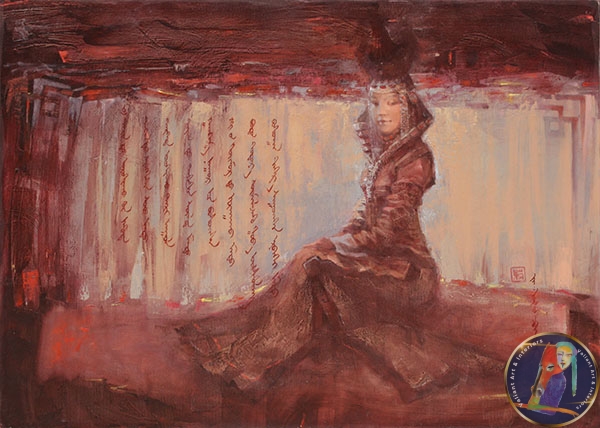
“Mongolian Queen 10” is a striking figurative oil painting that blends historical grandeur with contemporary stylistic execution. Positioned centrally within a vertical 50 x 70 cm canvas, the subject is a noble Mongolian woman portrayed from the waist up. She is depicted with a serene, enigmatic expression that carries an air of regal detachment and quiet strength.
The composition relies on a balanced, nearly symmetrical arrangement that draws immediate focus to the intricate textures of her traditional attire and the soulful features of her face. The artist bridges the academic rigor of his European training (The Institute of Industrial Art, Kharkiv) with profound nomadic heritage, resulting in a portrait that feels both deeply rooted in Mongolian history and distinctly modern.
Costume and Ornamentation
The focal point of the artwork is the meticulous rendering of traditional Mongolian royal regalia, specifically the Deel (gowns) and the ornate Khalkha female headdress.
The Headdress: The towering, elaborate headdress dominates the upper half of the canvas. The artist uses precise, layered brushwork to depict the complex silver work, coral beads, and turquoise inlays characteristic of historical aristocratic ornaments. Long, decorative side-flaps (Shanaany Shimeg) frame the queen’s face, heavily adorned with cascading strands of pearls and engraved metal plates that catch the light with subtle metallic glints.
The Attire: The queen wears a high-collared, structured Deel fashioned from rich, heavy silk brocade. The fabric is rendered with deep, saturated jewel tones, featuring woven patterns of traditional geometric and floral motifs. The shoulders are subtly structured, lending a statuesque quality to her posture.
Color Palette and Light
The color palette strikes a sophisticated balance between rich, earthy undertones and vibrant accents.
Dominant Tones: Deep crimsons, burnt oranges, and midnight blues dominate the textile elements, while the metallic ornaments introduce cool silver grays and warm, tarnished gold hues.
Skin Tones: The queen’s skin is rendered with soft, blended transitions, featuring a smooth, luminous complexion that contrasts effectively against the hard, textured surfaces of the jewelry.
Lighting: The illumination is soft and directional, as if coming from a single, low ambient source typical of a traditional Ger interior. This creates gentle shadows that define the contours of her face, the bridge of her nose, and the high cheekbones, adding psychological depth to her gaze.
Brushwork and Texture
Usukhbayar Zagd displays a masterful command of texture through varied oil applications:
Precision and Detail: The jewelry, silver filigree, and intricate embroidery on the collar are executed with fine, controlled brushstrokes, capturing the tactile qualities of polished stone, cold metal, and woven thread.
Atmospheric Background: In contrast to the highly detailed subject, the background is kept deliberately minimalist and atmospheric. Utilizing broader, softer brushstrokes and blended gradients of muted brown, ochre, and deep amber, the background recedes completely. This intentional lack of environmental context isolates the figure, elevating her from a specific historical setting into a timeless, iconic symbol of Mongolian queenship.