
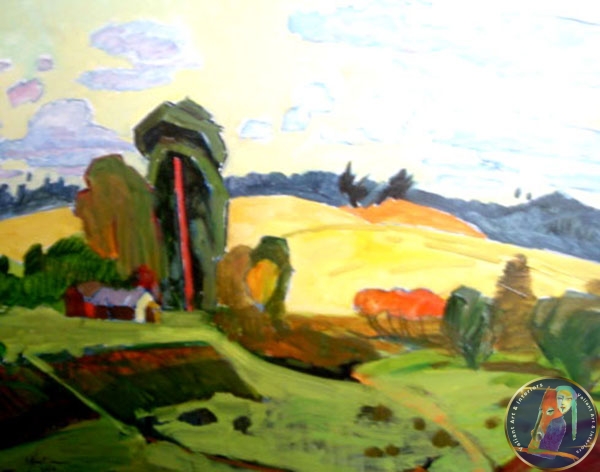
Mongolian Nature is a vibrant testament to the vast, rhythmic beauty of the Central Asian steppe. Rendered with the technical precision of the Repin Academy tradition and infused with a distinctly Mongolian sensibility, the painting captures a panoramic view of an undulating landscape under a vast, expressive sky.
Composition and Palette The composition is structured through a series of receding horizontal planes that guide the viewer’s eye from the textured foreground to the distant, hazy peaks of the horizon. Yadamsuren employs a rich, earthy palette dominated by:
Ochres and Russets: Suggesting the hardy grasses of the late summer or autumn steppe.
Deep Veridian and Emerald: Marking the presence of water sources or sheltered valleys.
Cerulean and Soft Lavenders: Used in the sky and distant mountain ranges to create a sense of atmospheric perspective and immense scale.
Subject Matter While the title emphasizes “Nature,” the human element is subtly integrated, reflecting the nomadic philosophy of living in harmony with the environment. Scattered across the mid-ground are white, circular forms—Gers (yurts)—appearing as small pearls against the massive green and gold backdrop. Nearby, gestural brushstrokes suggest herds of livestock (horses or sheep) grazing, which lends the scene a sense of quiet movement and vitality.
Technique and Style Yadamsuren’s brushwork reveals her sophisticated training in St. Petersburg. The sky is treated with a fluid, painterly touch, where clouds are not static objects but swirling masses of light and shadow, suggesting the unpredictable weather of the high plateau. In contrast, the terrain is built with more deliberate, layered strokes that convey the rugged topography and the physical “weight” of the land.
Contextual Significance
As an artist educated during the transition of Mongolian art from traditional Mongol Zurag styles to Western academic realism, Yadamsuren’s work represents a sophisticated synthesis. Mongolian Nature is not merely a topographical record; it is an emotional portrait of a homeland. The painting reflects the “Creation” era of the 1990s—a period following Mongolia’s democratic transition—where artists began to explore national identity and the timeless beauty of the countryside with renewed personal freedom.
This piece remains a quintessential example of late 20th-century Mongolian landscape painting, balancing the grandeur of the natural world with the intimate traces of nomadic life.