
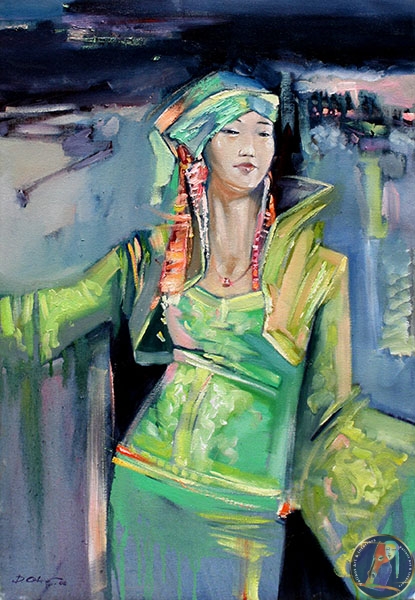
Mongolian Lady

Otgonbayar Khisheg , 2008 , Oil On Canvas

Produced during a pivotal year in Otgonbayar Khisheg’s early career—the same year it was showcased at the Beijing International Art ExpoMongolian Lady is a masterclass in contemporary realism. The work captures the soulful essence of Mongolian heritage through a singular, figurative lens, blending the harshness of the steppe’s climate with the refined elegance of traditional aesthetics.

Composition and Subject

The painting features a central figure of a woman, rendered with an intimate, photographic clarity that defines Khisheg’s Realism style.

  • The Portrait: The lady’s face serves as the emotional anchor of the piece. Khisheg utilizes a sophisticated play of light and shadow to highlight the weather-beaten yet graceful texture of her skin, suggesting a life lived in harmony with nature.

  • Attire: She is adorned in traditional Mongolian garments, likely a deel. The artist pays meticulous attention to the textile’s weave and the intricate patterns of the embroidery, using the 60 x 90 cm space to allow these details to breathe without crowding the frame.

  • The Gaze: Her expression is one of quiet strength and stoicism, a hallmark of Khisheg’s figurative work, which often seeks to personify the enduring spirit of the Mongolian people.

Style and Technique

  • Nature-Infused Realism: While the focus is figurative, the influence of Nature is palpable in the earthy color palette. Khisheg employs ochres, deep reds, and sky-toned blues that mirror the natural landscape of Ulaanbaatar and the surrounding provinces.

  • The Oil Medium: The use of oil allows for a luminous quality in the skin tones and a heavy, tactile feel to the traditional jewelry and headgear, giving the subject a three-dimensional presence.

  • Atmosphere: The background is often treated with a soft, blurred focus (bokeh effect), ensuring that the viewer’s eye remains locked on the human element, emphasizing the “Portrait” style over the environment.

  • Otgonbayar Khisheg
  • Calligraphy, Realism
  • Oil On Canvas
  • OTB78/006
  • 60 x 90cm
  • Mongolian Art Gallery

Add Your Comment

Mongolian Art Gallery © 2025. All Rights Reserved
Privacy Policy / Terms of Use

Produced during a pivotal year in Otgonbayar Khisheg’s early career—the same year it was showcased at the Beijing International Art ExpoMongolian Lady is a masterclass in contemporary realism. The work captures the soulful essence of Mongolian heritage through a singular, figurative lens, blending the harshness of the steppe’s climate with the refined elegance of traditional aesthetics.

Composition and Subject

The painting features a central figure of a woman, rendered with an intimate, photographic clarity that defines Khisheg’s Realism style.

  • The Portrait: The lady’s face serves as the emotional anchor of the piece. Khisheg utilizes a sophisticated play of light and shadow to highlight the weather-beaten yet graceful texture of her skin, suggesting a life lived in harmony with nature.

  • Attire: She is adorned in traditional Mongolian garments, likely a deel. The artist pays meticulous attention to the textile’s weave and the intricate patterns of the embroidery, using the 60 x 90 cm space to allow these details to breathe without crowding the frame.

  • The Gaze: Her expression is one of quiet strength and stoicism, a hallmark of Khisheg’s figurative work, which often seeks to personify the enduring spirit of the Mongolian people.

Style and Technique

  • Nature-Infused Realism: While the focus is figurative, the influence of Nature is palpable in the earthy color palette. Khisheg employs ochres, deep reds, and sky-toned blues that mirror the natural landscape of Ulaanbaatar and the surrounding provinces.

  • The Oil Medium: The use of oil allows for a luminous quality in the skin tones and a heavy, tactile feel to the traditional jewelry and headgear, giving the subject a three-dimensional presence.

  • Atmosphere: The background is often treated with a soft, blurred focus (bokeh effect), ensuring that the viewer’s eye remains locked on the human element, emphasizing the “Portrait” style over the environment.