Mongol Queen

Oyunchimeg Yadamsuren , 2007 , Oil On Canvas

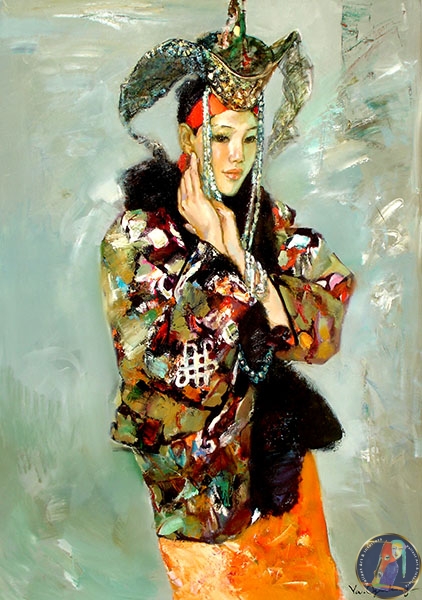
Mongol Queen is a commanding portrait that blends the rigorous technical discipline of the Repin Academy with the rich, symbolic heritage of Mongolian traditional aesthetics. The painting depicts a noble figure positioned centrally, radiating a sense of quiet authority and timeless elegance.

Composition and Style

The composition is characterized by its grand scale and vertical orientation, emphasizing the stature of the subject. Yadamsuren utilizes a rich, saturated palette that leans into deep reds, golds, and earth tones, typical of royal Mongolian iconography. The brushwork reveals a sophisticated balance between the Russian Academic style—evident in the realistic rendering of facial features and skin tones—and the flat, decorative patterns often found in Mongol Zurag (traditional Mongolian painting).

Subject Details

  • The Queen: The subject is portrayed with a serene yet piercing gaze. Her posture is formal and upright, embodying the dignity of her station.

  • Attire and Regalia: A focal point of the work is the intricate detail of the Deel (traditional robe) and the elaborate Boqta (headdress). The artist meticulously renders the textures of silk brocade, heavy embroidery, and precious inlays of turquoise and coral.

  • Symbolism: The ornaments worn by the Queen are not merely decorative; they serve as a visual lexicon of Mongolian history and status. The interplay of light on the metallic elements of her jewelry provides a luminous contrast to the matte, deep-toned background.

Artistic Context

Created by an artist educated during a pivotal era of Mongolian art history (1960s–1970s), this piece represents the bridge between Western oil painting techniques and Central Asian cultural identity. It reflects Yadamsuren’s mastery in capturing both the physical likeness and the spiritual weight of a historical archetype, making it a significant example of modern Mongolian portraiture.
  • Oyunchimeg Yadamsuren
  • Sukhbaatar, Mongolia
  • Nature, Portrait, Realism, Still Life
  • Oil on canvas
  • OYU45/004
  • 124 x 92cm48" x 36"
  • Valiant Art & Interiors

Add Your Comment

Mongolian Art Gallery © 2025. All Rights Reserved
Privacy Policy / Terms of Use

Mongol Queen is a commanding portrait that blends the rigorous technical discipline of the Repin Academy with the rich, symbolic heritage of Mongolian traditional aesthetics. The painting depicts a noble figure positioned centrally, radiating a sense of quiet authority and timeless elegance.

Composition and Style

The composition is characterized by its grand scale and vertical orientation, emphasizing the stature of the subject. Yadamsuren utilizes a rich, saturated palette that leans into deep reds, golds, and earth tones, typical of royal Mongolian iconography. The brushwork reveals a sophisticated balance between the Russian Academic style—evident in the realistic rendering of facial features and skin tones—and the flat, decorative patterns often found in Mongol Zurag (traditional Mongolian painting).

Subject Details

  • The Queen: The subject is portrayed with a serene yet piercing gaze. Her posture is formal and upright, embodying the dignity of her station.

  • Attire and Regalia: A focal point of the work is the intricate detail of the Deel (traditional robe) and the elaborate Boqta (headdress). The artist meticulously renders the textures of silk brocade, heavy embroidery, and precious inlays of turquoise and coral.

  • Symbolism: The ornaments worn by the Queen are not merely decorative; they serve as a visual lexicon of Mongolian history and status. The interplay of light on the metallic elements of her jewelry provides a luminous contrast to the matte, deep-toned background.

Artistic Context

Created by an artist educated during a pivotal era of Mongolian art history (1960s–1970s), this piece represents the bridge between Western oil painting techniques and Central Asian cultural identity. It reflects Yadamsuren’s mastery in capturing both the physical likeness and the spiritual weight of a historical archetype, making it a significant example of modern Mongolian portraiture.