
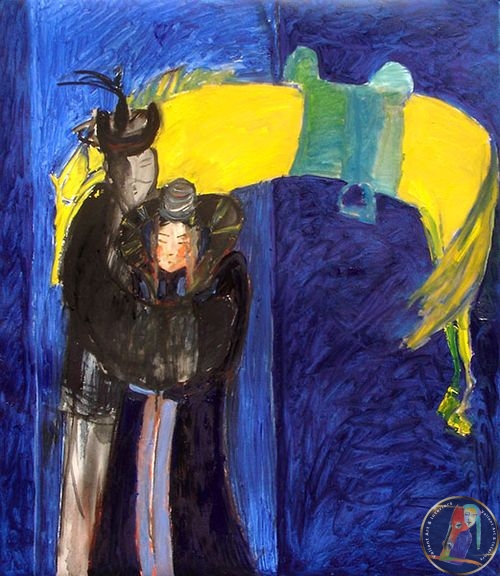
Love, a 2006 oil on canvas by Otgontugs Dondovdorj, serves as a compelling exploration of human connection through the lens of Mongolian contemporary figurative abstraction. Measuring $75.5 \times 65.5\text{ cm}$, the work captures a pivotal moment in the artist’s early career, created shortly after his graduation from the Mongolian University of Arts and Culture.
Visual Composition and Style
The painting strikes a sophisticated balance between figurative realism and expressive modernism. Dondovdorj utilizes the tactile quality of oil to build a surface that feels both intimate and expansive. The central focus remains on the subjects, yet the artist employs abstract elements to blur the boundaries between the figures and their environment, suggesting that the emotion of “Love” transcends physical space.
Form and Line: The brushwork reflects the artist’s formal training, showcasing a mastery of human anatomy while intentionally softening edges to evoke a dreamlike or memory-esque quality.
Color Palette: Typical of the “New Art” movement in Ulaanbaatar during the mid-2000s, the palette likely balances earthy, traditional Mongolian tones with vibrant, emotive highlights that underscore the painting’s title.
Symbolism: Rather than a literal depiction, the 2006 piece leans into the Contemporary Portrait style, focusing on the psychological state of the subjects. The composition emphasizes proximity and shared space, hallmarks of Dondovdorj’s figurative approach.
Curatorial Context
Produced during a highly active period for the artist, Love was created the same year Dondovdorj participated in the “New Art” joint exhibition at the Zanabazar Fine Art Museum and the “Young Artist” exhibition at Hanadu Art Gallery.
This work represents the vanguard of the 1980s-born generation of Mongolian artists who moved away from strict socialist realism toward a more personalized, international aesthetic. The piece reflects the cultural shift in Ulaanbaatar’s art scene during the mid-2000s—a period marked by a synthesis of nomadic heritage and global modernism.