

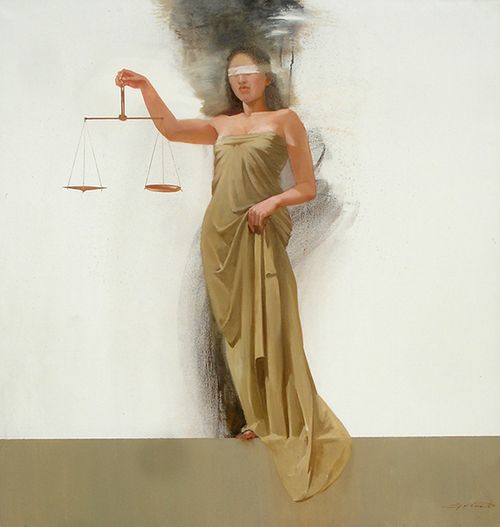
Libra, painted in 2008, stands as a masterful culmination of Erdene Dash’s rigorous academic training and his profound connection to the Mongolian landscape. Executed in oil on a nearly square canvas, the work is a harmonious blend of figurative realism and evocative naturalism. It captures a moment of stillness that feels both intimately human and cosmically balanced.
Composition and Subject Matter
The painting features a central nude figure, rendered with the anatomical precision characteristic of Dash’s education at the Repin Academy of Arts. The figure is integrated seamlessly into a vast, open landscape, suggesting a symbiotic relationship between the human form and the earth.
The Figure: The skin tones are layered with subtle glazes to capture the play of natural light, emphasizing the soft curves and muscular underlying structure. The pose is one of equilibrium—referencing the “Scales” of the Libra zodiac—evoking a sense of internal peace and physical weightlessness.
The Landscape: The background reflects the artist’s Mongolian roots, utilizing a palette of earthy ochres, muted greens, and expansive sky blues. The horizon line is positioned to give the figure a monumental presence, while the atmospheric perspective creates a sense of infinite distance.
Style and Technique
Dash employs Realism not merely as a decorative tool, but as a means to explore the sanctity of nature.
Brushwork: The artist uses a sophisticated “Academic” approach, where the brushwork is polished and controlled in the rendering of the flesh, contrasting with more expressive, textural strokes in the surrounding terrain and flora.
Light and Shadow: There is a gentle, diffused light source that mimics the “golden hour” of the steppe, casting soft shadows that define the figure’s volume without creating harsh boundaries.
Symbolism and Mood
The title Libra serves as the conceptual anchor for the piece. It represents the search for balance—between the physical and the spiritual, the individual and the environment, and the rigid discipline of Russian Realism and the fluid beauty of the natural world. The painting carries a quiet, contemplative energy, inviting the viewer to observe the body as a natural element, no different from the hills or the sky.
