
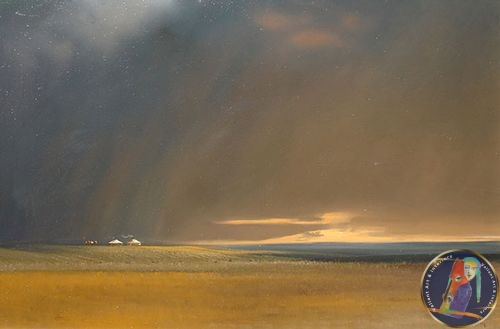
Little Light is a masterclass in Photorealism and atmospheric storytelling, characteristic of Khurelbaatar Choindon’s rigorous training at the Repin Academy. Despite its modest dimensions, the painting captures an expansive, intimate moment within the rugged Mongolian landscape.
Visual Composition and Subject Matter
The painting centers on a solitary, illuminating source—the “little light” of the title—which acts as the focal point against a vast, darkening horizon. The composition likely features a traditional Mongolian setting, such as a lone ger (yurt) or a small campfire, nestled into the undulating curves of the steppe.
Choindon uses the landscape not merely as a backdrop, but as a living participant. The earth is rendered with tactile precision, showing the parched textures of the soil and the sparse, hardy vegetation of the Mongolian plains. The transition from the grounded reality of the terrain to the ethereal quality of the sky demonstrates his command of Realism.
Light and Color Palette
The true subject of the piece is the interplay between warmth and cold:
The “Little Light”: Rendered in concentrated ochres, ambers, and brilliant whites, the light source creates a soft “halo” effect, pushing back the encroaching shadows.
The Twilight Sky: Choindon employs a sophisticated gradient of deep indigos, violets, and bruised purples to signify the “blue hour” of the Mongolian evening.
Chiaroscuro Influence: There is a clear nod to his classical Russian education in the way he handles Chiaroscuro. The stark contrast between the glowing interior/hearth and the infinite, cooling exterior creates a profound sense of isolation and resilience.
Style and Technique
As a proponent of Figurative Realism, Choindon avoids abstraction, opting instead for a clarity that feels almost documentary. Every brushstroke is disciplined; the smoke from the light source might be a delicate, translucent veil, while the shadows are deep and layered, giving the canvas a three-dimensional weight.
The painting evokes a quiet, meditative mood. It reflects the nomadic spirit—the idea of a small, human warmth existing bravely within the overwhelming scale of nature. It is an exploration of “home” as a flickering point of light in an immense, beautiful void.