Landscape

Nurmaajav Tuvdendorj , 2006 , Watercolor

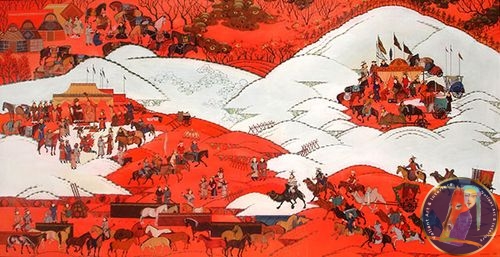
This expansive watercolor reflects the vastness of the Mongolian steppe, executed with the delicate precision characteristic of Tuvdendorj’s training in traditional Mongolian Painting (Mongol Zurag). Measuring nearly 1.7 meters in width, the composition emphasizes a panoramic horizontal perspective that mirrors the infinite horizons of the artist’s homeland.

  • Composition and Perspective: The painting utilizes a distinctive “bird’s-eye” or multi-focal perspective common in Uighur and traditional Mongolian art styles. Rather than a single vanishing point, the landscape unfolds in layers. The foreground likely features intricate details of nomadic life or native flora, transitioning into rolling hills and distant, ethereal mountain ranges that fade into the paper’s natural grain.

  • Color Palette: Given the watercolor medium, the work likely employs a palette of soft, earth-toned washes—ochres, dusty greens, and pale blues. There is a luminous quality to the light, suggesting the clarity of the high-altitude Mongolian atmosphere. The artist’s background in Still Life manifests in the meticulous rendering of small elements within the broader landscape, such as the texture of steppe grass or the structural details of a distant settlement.

  • Stylistic Influence: Having defended a thesis on Uighur Culture (Uigur Soyol), Tuvdendorj infuses the landscape with historical resonance. The lines are fluid yet disciplined, blending the decorative, flat-color aesthetic of ancient Central Asian frescoes with a modern, atmospheric sensibility.


Context and Significance

Created in 2006—just one year after Tuvdendorj completed her Bachelor’s degree—Landscape represents a pinnacle of her early professional period. It bridges the gap between her academic study of traditional motifs and her personal exploration of Mongolian identity.

The work’s scale and detail reflect the “New Era” of Mongolian art, where artists like Tuvdendorj move away from Socialist Realism toward a style that honors indigenous heritage while embracing the expressive freedom of contemporary watercolor techniques.
  • Nurmaajav Tuvdendorj
  • Minimalist, Mongolian Style
  • Watercolor
  • NUR75/001
  • 87 x 169cm
  • Mongolian Art Gallery

Add Your Comment

Mongolian Art Gallery © 2025. All Rights Reserved
Privacy Policy / Terms of Use

This expansive watercolor reflects the vastness of the Mongolian steppe, executed with the delicate precision characteristic of Tuvdendorj’s training in traditional Mongolian Painting (Mongol Zurag). Measuring nearly 1.7 meters in width, the composition emphasizes a panoramic horizontal perspective that mirrors the infinite horizons of the artist’s homeland.

  • Composition and Perspective: The painting utilizes a distinctive “bird’s-eye” or multi-focal perspective common in Uighur and traditional Mongolian art styles. Rather than a single vanishing point, the landscape unfolds in layers. The foreground likely features intricate details of nomadic life or native flora, transitioning into rolling hills and distant, ethereal mountain ranges that fade into the paper’s natural grain.

  • Color Palette: Given the watercolor medium, the work likely employs a palette of soft, earth-toned washes—ochres, dusty greens, and pale blues. There is a luminous quality to the light, suggesting the clarity of the high-altitude Mongolian atmosphere. The artist’s background in Still Life manifests in the meticulous rendering of small elements within the broader landscape, such as the texture of steppe grass or the structural details of a distant settlement.

  • Stylistic Influence: Having defended a thesis on Uighur Culture (Uigur Soyol), Tuvdendorj infuses the landscape with historical resonance. The lines are fluid yet disciplined, blending the decorative, flat-color aesthetic of ancient Central Asian frescoes with a modern, atmospheric sensibility.


Context and Significance

Created in 2006—just one year after Tuvdendorj completed her Bachelor’s degree—Landscape represents a pinnacle of her early professional period. It bridges the gap between her academic study of traditional motifs and her personal exploration of Mongolian identity.

The work’s scale and detail reflect the “New Era” of Mongolian art, where artists like Tuvdendorj move away from Socialist Realism toward a style that honors indigenous heritage while embracing the expressive freedom of contemporary watercolor techniques.