
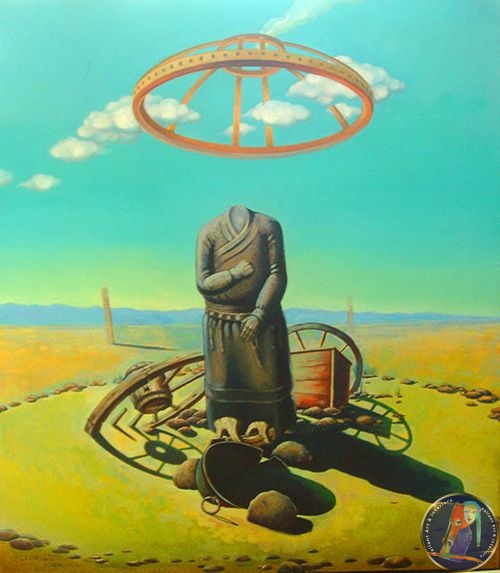
Land of Great Ger (2005) is a compelling oil on canvas work by the late Mongolian master Lkhamsuren Nyamkhuu. Measuring 77.5 x 93 cm, the painting is a profound exploration of Mongolian identity, blending traditional nomadic symbolism with a modern, almost surrealist aesthetic.
Visual Description
The composition is dominated by the titular “Great Ger,” which is rendered not merely as a dwelling but as a monumental, sacred structure. Nyamkhuu utilizes a rich, earthy palette—deep ochres, weathered ambers, and dusty blues—to evoke the timeless atmosphere of the Central Asian steppe.
Key Elements:
The Central Ger: Unlike a standard nomadic tent, this “Great Ger” is depicted with exaggerated proportions and intricate patterns on its felt covers and doorframe. It appears as an anchor between the earth and the sky, symbolizing the spiritual heart of the nation.
Atmospheric Perspective: The background features a sweeping, stylized landscape of rolling hills and a vast, emotive sky. The brushwork is textured and deliberate, giving the clouds a heavy, tactile quality that mirrors the weight of history.
Light and Shadow: Nyamkhuu employs a dramatic use of light, often suggesting a low sun—either dawn or dusk—that casts long, soft shadows and highlights the cylindrical volume of the Ger, making it glow against the darker tones of the landscape.
Cultural Symbolism: Subtle motifs often found in Nyamkhuu’s work, such as traditional Mongolian “ulzii” (eternal knots) or livestock silhouettes, are integrated into the texture of the painting, emphasizing the symbiotic relationship between the people and their environment.
About the Artist: Lkhamsuren Nyamkhuu (1948–2016)
Nyamkhuu was a pivotal figure in the transition of Mongolian art from socialist realism to more expressive, individualistic styles. His education at the Institute of Fine Art in Ulaanbaatar provided a rigorous classical foundation, which he later infused with a deep sense of Mongolian heritage and personal philosophy.
Artistic Legacy
Nyamkhuu’s work is characterized by a “quiet strength.” His global exhibition history—spanning from the United States and Western Europe to Japan and Southeast Asia—demonstrates his ability to translate the specific beauty of the Mongolian landscape into a universal visual language. Land of Great Ger stands as a testament to his career-long obsession with the “Ger” as a symbol of cosmic order and domestic peace.