
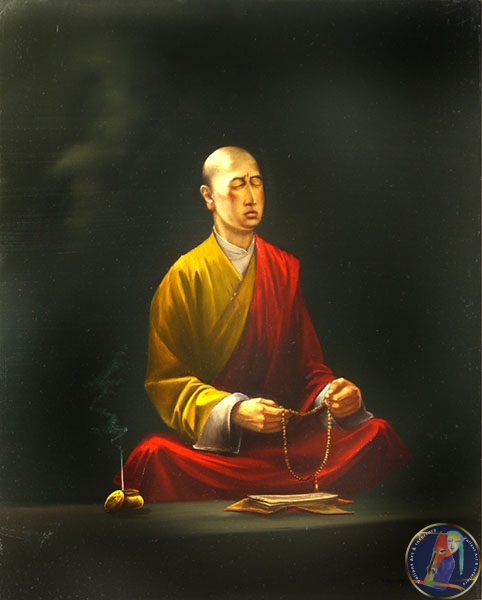
Lama 1 is a masterclass in photorealism and figurative portraiture, capturing the quiet, spiritual essence of a Mongolian Buddhist practitioner. The painting focuses on the subject from the chest up, set against a muted, non-distracting background that pushes the figure into the immediate foreground, creating an intimate connection between the subject and the viewer.
Subject and Composition
The central figure is an elderly Lama, his face etched with the deep lines of age, wisdom, and the harsh climate of the Mongolian steppe. Choindon utilizes his training from the Repin Academy of Fine Art to achieve a staggering level of anatomical precision.
The Face: The skin is rendered with incredible detail, showing every wrinkle, age spot, and the subtle texture of the pores. His eyes, though aged, carry a sharp, lucid clarity, reflecting a lifetime of meditation and discipline.
Attire: The Lama is dressed in traditional monastic robes. The deep crimson and saffron hues are applied with nuanced gradients, showing the weight and fold of the heavy fabric. The play of light on the shoulder of the robe suggests a single, natural light source coming from the side, highlighting the artist’s command over Chiaroscuro.
Style and Technique
Consistent with Choindon’s reputation for Realism, the brushwork is nearly invisible. The transitions between light and shadow are seamless, giving the portrait a three-dimensional quality that mimics the depth of a high-resolution photograph.
Despite the technical rigidity of photorealism, the painting feels deeply soulful. It does not merely document the man’s features; it captures a specific “Mongolian” identity—one of resilience and spiritual tranquility. The compact size of the canvas (40.5 x 50.5 cm) further enhances the sense of a private, sacred moment, as if the viewer is sitting directly across from the Lama in a quiet monastery cell.
Contextual Significance
Created in 2006, while Choindon served as the Vice Chairman of the Union of Mongolian Artists (UMA), this work represents the pinnacle of contemporary Mongolian realism. It blends the strict academic traditions of Russian fine arts (from his time in St. Petersburg) with the intrinsic cultural and religious heritage of Mongolia.