
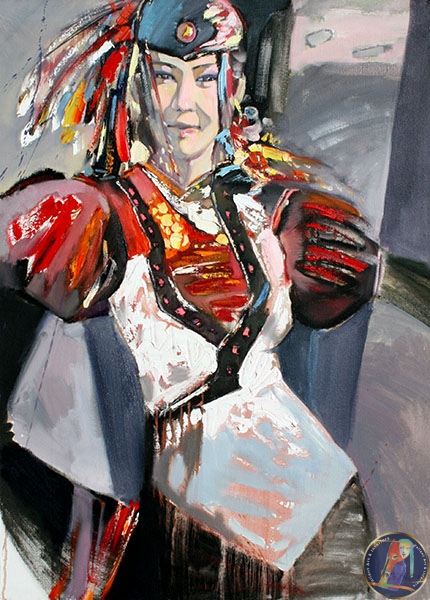
Lady Composition 1 is a compelling synthesis of classical realism and contemporary figurative art. Painted in 2009 by Mongolian artist Otgonbayar Khisheg, this work serves as an intimate exploration of feminine grace, cultural identity, and the quietude of nature. At 92 x 66 cm, the vertical orientation focuses the viewer’s attention on a singular, evocative subject, rendered with the meticulous precision characteristic of Khisheg’s early career.
Visual Composition and Style
The painting exemplifies the Realism style, showcasing the artist’s technical mastery over light and texture. The subject—a young woman—is depicted with a lifelike clarity that captures the subtle nuances of human skin and the soft luster of hair.
The Subject: The “Lady” is positioned as the central figurative element. Her expression is often noted for its contemplative, almost ethereal quality, reflecting a blend of traditional Mongolian stoicism and modern vulnerability.
Color Palette: Khisheg utilizes a sophisticated palette of earth tones, deep ambers, and soft flesh tints. The background often integrates elements of Nature, where organic textures—perhaps flowing water, flora, or dappled light—merge seamlessly with the figure to suggest a deep connection between the human form and the natural world.
Lighting: The use of chiaroscuro (the contrast between light and dark) provides a three-dimensional depth to the canvas, making the figure appear as though she is emerging from a dreamlike, atmospheric space.
Artistic Context
Born in Ulaanbaatar in 1986, Otgonbayar Khisheg represents a generation of Mongolian artists who bridge the gap between nomadic heritage and global academic art standards.
Cultural Significance: While the technique is rooted in Western oil painting traditions, the “soul” of the piece remains distinctly Mongolian. The poise of the subject hints at the dignity and resilience of the artist’s homeland.
Historical Milestone: This specific composition was part of the era leading up to Khisheg’s international recognition, shortly after his participation in the 2008 Beijing International Art Expo. It stands as a testament to his burgeoning reputation as a master of the Portrait genre in East Asia.