
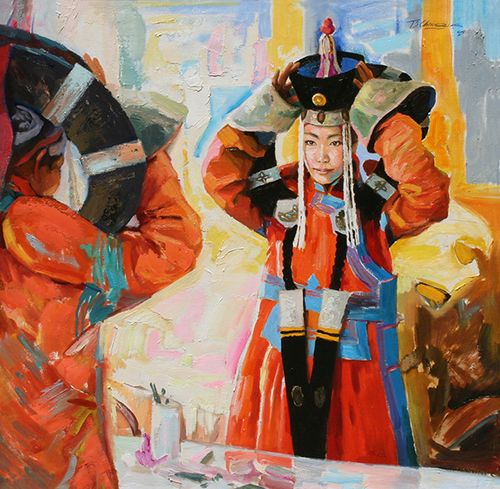
The painting features a central female figure, rendered with the clinical precision of Photorealism. Tulgabaatar utilizes the large-scale format to capture hyper-fine details—the individual strands of hair catching the light, the subtle translucency of the subject’s skin, and the reflective depth in her eyes.
The “Lady” is positioned as the focal point of a Figurative Art study, yet she does not exist in a vacuum. She is integrated into a backdrop that shifts between Landscape and Nature, often characterized by the soft, diffused light of the Mongolian steppe or high-altitude environments.
The Palette: The artist employs a sophisticated range of earth tones—ochres, soft browns, and cool slate greys—offset by the warm, lifelike hues of the subject’s complexion.
The Lighting: There is a cinematic quality to the light source, which appears to be natural and directional, creating soft shadows that define the bone structure of the face and the folds of her clothing.
Style and Technique
While the work is rooted in Realism, Tulgabaatar’s approach to the medium of oil is exceptionally smooth, minimizing visible brushstrokes to achieve a photographic finish.
Portraiture vs. Landscape: The painting masterfully balances two scales. Up close, the viewer is confronted with the raw, emotive reality of the portrait. From a distance, the composition reveals a deep appreciation for the vastness of the natural world, a hallmark of the artist’s Ulaanbaatar roots.
Atmospheric Perspective: The background often features a blurred or “bokeh” effect, a technique borrowed from photography that ensures the viewer’s gaze remains locked on the subject while still sensing the immense scale of the environment behind her.
Context of the Artist
Born in 1985 in Ulaanbaatar, Chinggis Tulgabaatar belongs to a generation of Mongolian artists who bridged traditional nomadic themes with global contemporary techniques. In 2008, at the age of 23, Tulgabaatar was already demonstrating a technical mastery over oil paint that rivaled established masters, using the “Lady” as a vessel to explore the quiet strength and timelessness associated with Mongolian identity.