
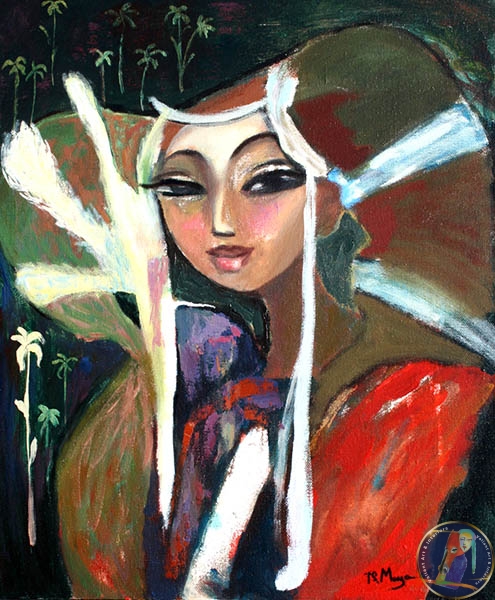
This evocative work by Mongolian artist Mydagmaa Tserenpil serves as a bridge between her early academic roots and the minimalist, abstract style that would later define her career. Measuring 45 x 55 cm, the medium-scale oil on canvas offers an intimate yet expansive look at the feminine form through a lens of cultural introspection.
Visual Composition and Style
“Lady” is a prime example of Tserenpil’s Minimalist Figurative approach. Rather than focusing on hyper-realistic anatomical detail, the artist uses the human figure as a topographical element, much like the landscapes of her native Bayankhongor.
Form and Line: The silhouette of the “Lady” is rendered with fluid, sweeping brushstrokes. There is a deliberate softening of edges, suggesting a figure that is emerging from—or receding into—the background.
Color Palette: Typical of her 2008 period, the palette likely favors earthy, organic tones. Expect a sophisticated interplay of ochres, deep ambers, and muted siennas, punctuated by cooler shadows that provide depth and volume to the canvas.
Spatial Relationship: The composition maintains a tension between the subject and the negative space. By utilizing a 45 x 55 cm landscape orientation for a portrait subject, Tserenpil creates a sense of environmental context, suggesting that the “Lady” is inseparable from the space she inhabits.
Conceptual Depth
Born in 1984, Tserenpil belongs to a generation of Mongolian artists who transitioned through the country’s post-socialist artistic “thaw.” In this painting:
Abstract Influence: The background is likely stripped of literal environmental markers, leaning into Abstraction. This forces the viewer to focus on the emotional resonance of the pose rather than a specific narrative setting.
Cultural Identity: While the style is contemporary and minimalist, there is an inherent weight to the work that reflects the stillness and vastness of the Mongolian steppe, translated here into the quiet dignity of a singular female figure.