

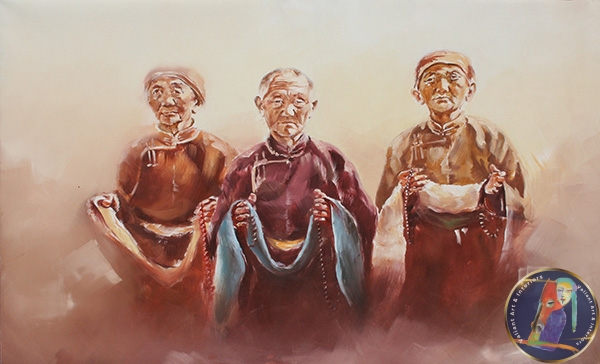
This detailed text-only description explores the visual elements, stylistic qualities, and cultural significance of the painting Khadag (2009) within the context of the artist’s background and thematic focus.
1. Composition and Visual Narrative
Khadag is a horizontally oriented oil painting measuring $60 \times 90\text{ cm}$ ($23 \times 35\text{ inches}$). Adhering to Ulziijavkhlan Adyabaatar’s signature realist and ecological style, the composition centers on a quiet, narrative snapshot of traditional nomadic life in the Mongolian countryside.
The painting is structured around the profound interrelationship between humanity, nature, and sacred local traditions. The foreground and midground focus on nomadic figures and native fauna—likely horses or livestock—set against the vast, open terrain characteristic of the Mongolian steppe or the artist’s native Dund Gobi province. The figures are rendered with deep figurative precision, capturing natural postures, weathered textures, and traditional garments that signal a life lived in harmony with the shifting elements.
2. The Central Motif: The Khadag
The emotional and symbolic anchor of the painting is the khadag, which gives the artwork its title. A khadag is a traditional ceremonial scarf, typically made of silk, that holds immense spiritual and cultural value in Mongolian nomadic tradition, Tibetan Buddhism, and Tengrism (shamanism).
In the painting, the khadag is rendered primarily in its most sacred color: a vibrant, luminous sky blue. In Mongolian culture, the blue khadag represents the Venerable Sky (Munkh Khukh Tengger) and signifies peace, goodwill, and the universe’s expansive nature. The artist captures the fine texture of the silk scarf as it interacts with the composition—either being offered with upturned hands as a gesture of deep respect, greeting, or blessing to an esteemed elder, or tied to a sacred natural marker (like an ovoo or a tree branch) to commune with the spirits of the land. The fluid, delicate folds of the blue fabric contrast beautifully against the rugged, organic textures of the background.
3. Color Palette and Atmosphere
The color palette reflects Adyabaatar’s dedication to capturing the profound serenity and “eco-art” essence of the region:
The Landscape: Earthy, grounded tones dominate the landscape—ochres, muted grassy greens, deep umbers, and sandy beiges that echo the arid beauty of the Middle Gobi.
The Sky and Lighting: A soft, natural light bathes the entire scene, creating a tranquil atmosphere. The vast sky overhead blends soft whites and hazy blues, mirroring the expanse below and evoking a sense of “great peacefulness.”
Accents: The brilliant sky-blue of the khadag acts as the primary focal point, drawing the viewer’s eye directly to the center of the cultural exchange or blessing taking place.
4. Style, Technique, and Materiality
Executed as an oil on canvas, the artwork highlights Adyabaatar’s masterful control over the medium. Her application of paint balances precise realism with a softer, painterly touch that emphasizes texture and atmosphere over sharp, clinical lines.
The brushwork captures the tactile differences between coarse animal hair, heavy wool or silk del (traditional coats), dry steppe earth, and the ethereal, flowing qualities of the ritual scarf. Rather than presenting Mongolian traditions as static or historical artifacts, her technique brings them to life as living, breathing elements of contemporary nomadic identity.
5. Cultural Context and Conceptual Meaning
Created in 2009, Khadag stands as a pivotal piece in Adyabaatar’s mission to preserve and pass down traditional Mongolian culture to younger generations. By documenting the ritual use of the khadag amid a sprawling, peaceful landscape, the painting acts as a visual love letter to a sustainable, spiritually connected way of life. It encapsulates the core ethos of her work: a world where humans, fauna, and flora exist not in conflict, but in an enduring, respectful dialogue.
