In The Gobi Zokhui

Rentsen Suren , 2005 , Oil On Canvas

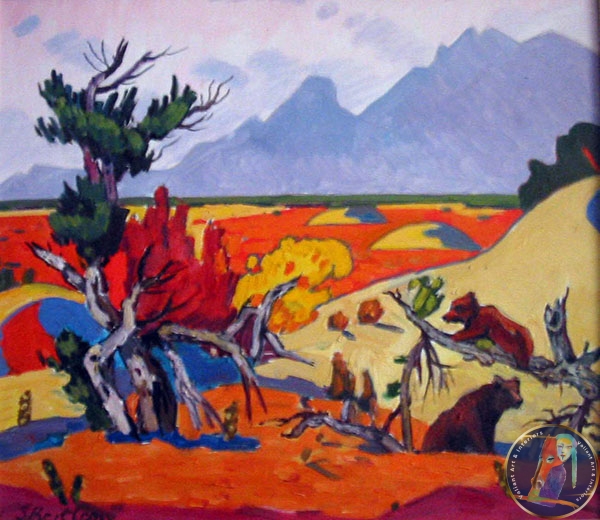
In The Gobi Zokhui is a compelling mid-century oil painting by the acclaimed Mongolian artist Rentsen Suren. Executed on a modest 40 x 45 cm canvas, the work captures the atmospheric essence and rugged beauty of the Gobi region. Suren, a master of the Mongolian aesthetic who was educated at the Art Secondary School and the Pedagogical University of Ulaanbaatar, utilizes a rich, textured palette to bring the desert landscape to life.

Composition and Style

The painting is characterized by its balanced yet dynamic composition, typical of Suren’s award-winning style from the 1950s and 60s. The artist employs a realist approach infused with traditional Mongolian sensibilities, focusing on the “Zokhui”—a term often referring to the harmony, arrangement, or composition of the natural world.

  • Color Palette: The canvas is dominated by earthy ochres, burnt siennas, and deep umbers, reflecting the arid soil of the Gobi. These warm tones are often punctuated by the sharp, brilliant blues of a vast Mongolian sky or the soft, hazy violets of distant mountain ranges.

  • Brushwork: Suren uses confident, layered brushstrokes to define the topography. The application of oil paint is deliberate, creating a sense of physical depth in the undulating dunes and rocky outcrops.

  • Light and Shadow: The artist expertly captures the harsh, direct light of the steppe, using high-contrast shadows to give volume to the land and evoke the quiet, expansive solitude of the region.

Thematic Elements

Reflecting the period in which Suren rose to prominence (winning top prizes at the Mongolian Youth Festival and the 40th Anniversary of the Republic Revolution), this piece serves as both a geographical study and a cultural tribute. It portrays the Gobi not as a wasteland, but as a structured, living environment. The “Zokhui” within the title suggests a deeper philosophical intent—finding the inherent order and beauty within the vast, seemingly chaotic desert expanse.

Historical Significance

As a work by a foundational figure in modern Mongolian art, In The Gobi Zokhui represents the transition of Mongolian painting from traditional “Mongol Zurag” influences toward Western-style oil techniques, all while maintaining a fiercely national identity. Its inclusion in a formal collection under accession number REN55/007 underscores its value as a preserved piece of Mongolian cultural heritage.
  • Rentsen Suren
  • Arkhangai, Mongolia
  • Landscape, Nature, Portrait, Realism
  • Oil on canvas
  • REN55/007
  • 40 x 45cm15" x "
  • Valiant Art & Interiors

Add Your Comment

Mongolian Art Gallery © 2025. All Rights Reserved
Privacy Policy / Terms of Use

In The Gobi Zokhui is a compelling mid-century oil painting by the acclaimed Mongolian artist Rentsen Suren. Executed on a modest 40 x 45 cm canvas, the work captures the atmospheric essence and rugged beauty of the Gobi region. Suren, a master of the Mongolian aesthetic who was educated at the Art Secondary School and the Pedagogical University of Ulaanbaatar, utilizes a rich, textured palette to bring the desert landscape to life.

Composition and Style

The painting is characterized by its balanced yet dynamic composition, typical of Suren’s award-winning style from the 1950s and 60s. The artist employs a realist approach infused with traditional Mongolian sensibilities, focusing on the “Zokhui”—a term often referring to the harmony, arrangement, or composition of the natural world.

  • Color Palette: The canvas is dominated by earthy ochres, burnt siennas, and deep umbers, reflecting the arid soil of the Gobi. These warm tones are often punctuated by the sharp, brilliant blues of a vast Mongolian sky or the soft, hazy violets of distant mountain ranges.

  • Brushwork: Suren uses confident, layered brushstrokes to define the topography. The application of oil paint is deliberate, creating a sense of physical depth in the undulating dunes and rocky outcrops.

  • Light and Shadow: The artist expertly captures the harsh, direct light of the steppe, using high-contrast shadows to give volume to the land and evoke the quiet, expansive solitude of the region.

Thematic Elements

Reflecting the period in which Suren rose to prominence (winning top prizes at the Mongolian Youth Festival and the 40th Anniversary of the Republic Revolution), this piece serves as both a geographical study and a cultural tribute. It portrays the Gobi not as a wasteland, but as a structured, living environment. The “Zokhui” within the title suggests a deeper philosophical intent—finding the inherent order and beauty within the vast, seemingly chaotic desert expanse.

Historical Significance

As a work by a foundational figure in modern Mongolian art, In The Gobi Zokhui represents the transition of Mongolian painting from traditional “Mongol Zurag” influences toward Western-style oil techniques, all while maintaining a fiercely national identity. Its inclusion in a formal collection under accession number REN55/007 underscores its value as a preserved piece of Mongolian cultural heritage.