

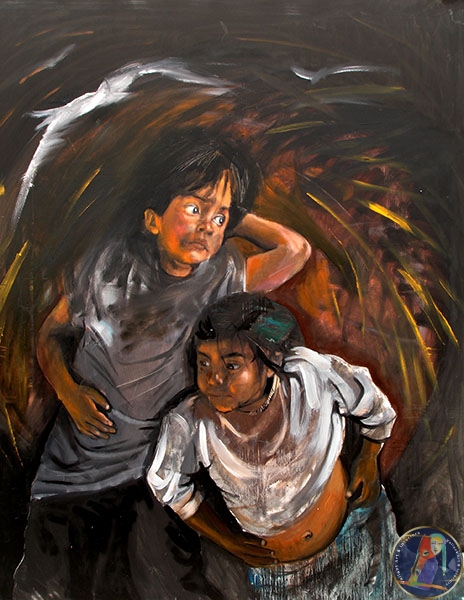
Huhuu, painted in 2007, is a compelling synthesis of Odgerel Tsulbaatar’s formal academic training and his leanings toward contemporary figurative abstraction. Created just two years after his graduation from the Fine Art University in Ulaanbaatar, the work captures a pivotal moment in the artist’s career as he navigated the rich cultural heritage of Mongolia through a modern, emotive lens.
Composition and Style
The painting utilizes a vertical format ($120 \times 100$ cm), providing a monumental scale that enhances its presence. Tsulbaatar blends figurative elements with modern abstraction, a hallmark of his style.
Figurative Depth: While the subject matter hints at a portrait or a character study (suggested by the title Huhuu, which often refers to the cuckoo bird in Mongolian folklore—a symbol of spring and shifting seasons), the forms are not strictly literal. They are softened and reimagined through a contemporary gaze.
Textural Quality: Using oil on canvas, the artist employs a sophisticated layering technique. There is a palpable tension between the smooth, blended areas of the portraiture and the more aggressive, expressive brushwork found in the background.
Color Palette and Atmosphere
The 2007 period of Tsulbaatar’s work often experimented with earthy, grounded tones interrupted by sharp, modern accents.
Tonal Harmony: Expect a balance of muted ochres, deep ambers, and shadowy umbers that reflect the natural Mongolian landscape, even within an abstract context.
Emotional Resonance: The “Seeking the Real Feel” philosophy mentioned in his 2006 exhibition history is evident here. The painting does not just represent a subject; it seeks to evoke the essence of the subject. The atmosphere is one of introspection and quiet strength.
Contextual Significance
Coming on the heels of the “Great Mongol 800” exhibition (2006), Huhuu represents the “New Art” movement in Ulaanbaatar. It moves away from traditional socialist realism and toward a more individualistic, psychological exploration.
The piece serves as a bridge between Tsulbaatar’s identity as a Mongolian-born artist and his aspirations within the global contemporary art scene. It reflects a generation of artists who are technically proficient in classical methods but choose to deconstruct those forms to find a more “real feel” for the 21st century.
