
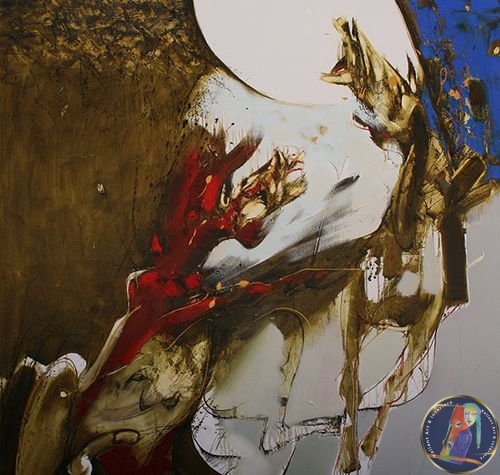
Enkhtaivan Ochirbat’s 2009 masterpiece, Horse Dancing 1, is a powerful testament to the fusion of Mongolian heritage and contemporary expressionism. Rendered in oil on a massive 150 x 150cm canvas, the work dominates the viewer’s field of vision, mirroring the vastness of the Central Asian steppe.
Composition and Form
The painting departs from traditional realism, leaning heavily into Contemporary Figurative Expressionism. The horse is not merely a subject but a kinetic force. Ochirbat uses sweeping, gestural brushstrokes to deconstruct the animal’s anatomy, focusing on the energy of movement rather than anatomical precision. The “dancing” aspect is conveyed through a swirling arrangement of limbs and mane, suggesting a creature caught in a moment of spirited, rhythmic exertion.
Color Palette and Texture
True to his association with Abstract Modernism, Ochirbat employs a rich, layered palette.
Earth Tones: Deep ochres, burnt siennas, and dusty browns ground the piece in the Mongolian landscape.
Dynamic Highlights: Flecks of brilliant white and sudden strokes of cool blues or vibrant reds cut through the earthy base, representing the flickering of light off a moving coat or the heat of the animal’s breath.
Impasto Technique: The oil paint is applied with varying thickness. Heavy, tactile ridges of paint create a 3D effect that captures the physical “heaviness” of the horse, while thinner, translucent glazes suggest the fleeting nature of wind and speed.
Symbolic Resonance
Born in Ulaanbaatar, Ochirbat draws from a culture where the horse is a symbol of freedom and survival. By presenting the horse in a square format (150 x 150cm), the artist creates a sense of tension—the wild, expansive energy of the “dance” is compressed within a perfect geometric boundary. This reflects the modern Mongolian experience: the ancient, nomadic spirit (the horse) navigating the structured, modern world (the square canvas).