Horse Composition

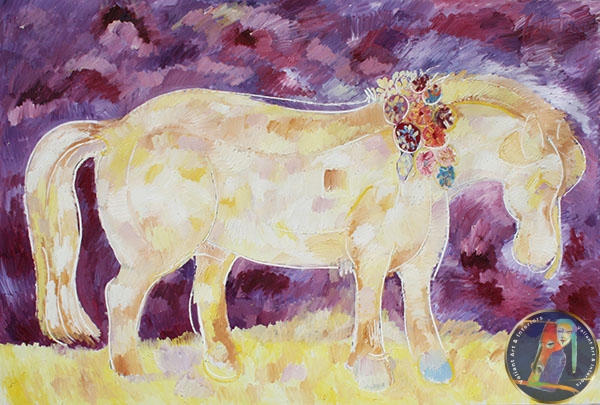
Saikhanbayar Banzardari , 2009 , Oil On Canvas

Horse Composition is a sweeping, large-format oil painting that captures the raw energy, cultural heritage, and spiritual essence of the Mongolian steppe. Given its substantial dimensions (100 x 150 cm), the canvas offers a panoramic view, dominant in its horizontal expanse, which naturally mirrors the vastness of the artist’s homeland.

The painting does not merely depict a singular, anatomical study of a horse; rather, as the title implies, it is a complex “composition” of multiple equine forms. The horses are arranged in a dynamic, overlapping sequence that suggests a powerful sense of motion—clashing, running, or gathering in a spirited herd. Banzardari utilizes a non-traditional, semi-abstracted approach to the figures. The forms of the horses bleed into one another and the surrounding environment, creating a rhythmic cadence across the canvas where the boundaries between animal, earth, and sky become beautifully blurred.

Color Palette and Atmosphere

Rooted in the natural palette of the Mongolian landscape, the color scheme balances earthy, grounded tones with vibrant, expressive bursts. Deep umbers, burnt siennas, and rich ochres establish the physical presence of the horses and the dust of the terrain. These warm, terrestrial colors are punctuated by strokes of cool cobalt blues, stark whites, and atmospheric greys, invoking the volatile weather of the high plains and the concept of the Tenger (the eternal blue sky in Mongolian cosmology). The interplay of light and shadow is not photographic but emotional, using high-contrast highlights to catch the crest of a mane, the curve of a flank, or the intense glint of an equine eye.

Brushwork and Technique

Executed in oil on canvas, the texture of the painting is tactile and energetic. Banzardari employs a masterfully fluid yet aggressive brush technique. Heavy impasto impels a sense of physical weight and texture, while swift, directional palette knife strokes and sweeping brush movements mimic the wind and the rapid momentum of galloping hooves. The paint is applied with varying degrees of density—some areas feature thick, layered pigment that stands out in relief, while others are rendered in looser, more atmospheric washes that give the composition a dreamlike, memory-infused quality.

Style and Cultural Context

Stylistically, the artwork sits at the intersection of European Expressionism and traditional Mongolian aesthetic sensibilities. Having been exhibited at the prestigious International Equestrian Festival in Lexington, Kentucky—a global hub for horse culture—the painting communicates a universal reverence for the animal while remaining deeply personal to Banzardari’s roots.

The horse is the ultimate symbol of nomadic freedom, strength, and survival in Mongolia. Through this piece, Banzardari bypasses rigid realism to capture the vibe and spirit (the Morin hiimori) of the creature. The abstracted, interwoven composition serves as a metaphor for the unbreakable bond between the Mongolian people, their history, and the natural world.
  • Saikhanbayar Banzardari
  • Erdenet City, Mongolia
  • Abstract, Figurative, Geometric, Minimalist
  • Oil on canvas
  • SBR/013
  • 100 x 150cm39" x "
  • Valiant Art & Interiors

Add Your Comment

Mongolian Art Gallery © 2025. All Rights Reserved
Privacy Policy / Terms of Use

Horse Composition is a sweeping, large-format oil painting that captures the raw energy, cultural heritage, and spiritual essence of the Mongolian steppe. Given its substantial dimensions (100 x 150 cm), the canvas offers a panoramic view, dominant in its horizontal expanse, which naturally mirrors the vastness of the artist’s homeland.

The painting does not merely depict a singular, anatomical study of a horse; rather, as the title implies, it is a complex “composition” of multiple equine forms. The horses are arranged in a dynamic, overlapping sequence that suggests a powerful sense of motion—clashing, running, or gathering in a spirited herd. Banzardari utilizes a non-traditional, semi-abstracted approach to the figures. The forms of the horses bleed into one another and the surrounding environment, creating a rhythmic cadence across the canvas where the boundaries between animal, earth, and sky become beautifully blurred.

Color Palette and Atmosphere

Rooted in the natural palette of the Mongolian landscape, the color scheme balances earthy, grounded tones with vibrant, expressive bursts. Deep umbers, burnt siennas, and rich ochres establish the physical presence of the horses and the dust of the terrain. These warm, terrestrial colors are punctuated by strokes of cool cobalt blues, stark whites, and atmospheric greys, invoking the volatile weather of the high plains and the concept of the Tenger (the eternal blue sky in Mongolian cosmology). The interplay of light and shadow is not photographic but emotional, using high-contrast highlights to catch the crest of a mane, the curve of a flank, or the intense glint of an equine eye.

Brushwork and Technique

Executed in oil on canvas, the texture of the painting is tactile and energetic. Banzardari employs a masterfully fluid yet aggressive brush technique. Heavy impasto impels a sense of physical weight and texture, while swift, directional palette knife strokes and sweeping brush movements mimic the wind and the rapid momentum of galloping hooves. The paint is applied with varying degrees of density—some areas feature thick, layered pigment that stands out in relief, while others are rendered in looser, more atmospheric washes that give the composition a dreamlike, memory-infused quality.

Style and Cultural Context

Stylistically, the artwork sits at the intersection of European Expressionism and traditional Mongolian aesthetic sensibilities. Having been exhibited at the prestigious International Equestrian Festival in Lexington, Kentucky—a global hub for horse culture—the painting communicates a universal reverence for the animal while remaining deeply personal to Banzardari’s roots.

The horse is the ultimate symbol of nomadic freedom, strength, and survival in Mongolia. Through this piece, Banzardari bypasses rigid realism to capture the vibe and spirit (the Morin hiimori) of the creature. The abstracted, interwoven composition serves as a metaphor for the unbreakable bond between the Mongolian people, their history, and the natural world.