
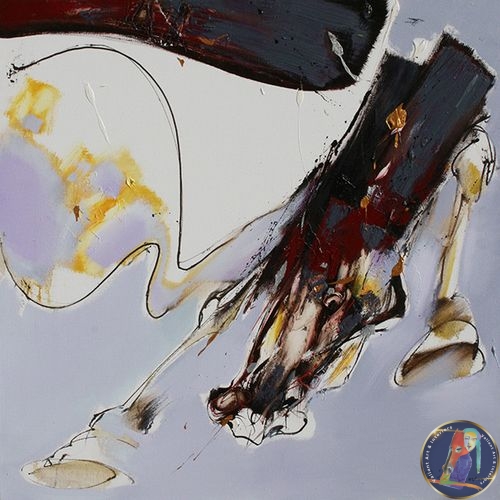
Horse Composition 4 is a striking example of Enkhtaivan Ochirbat’s ability to merge Contemporary Figurative elements with a raw, Expressionist energy. Painted in 2009, this oil-on-canvas work measures 70 x 70 cm, creating a balanced, square frame that contains a whirlwind of motion and color.
Composition and Subject Matter
The painting centers on the form of the horse, a motif deeply rooted in the artist’s Mongolian heritage. Rather than a static anatomical study, the “composition” focuses on the fluidity and spirit of the animal.
The Forms: The horses are not rendered with sharp outlines; instead, they emerge from the canvas through vigorous, overlapping brushstrokes. The bodies appear to bleed into one another, suggesting a herd in mid-gallop or the chaotic beauty of a dust-filled Mongolian steppe.
Space: True to the artist’s “Abstract Modern” style, the distinction between the foreground subjects and the background landscape is intentionally blurred. This creates a sense of infinite space and atmospheric depth.
Color Palette and Texture
Ochirbat utilizes a sophisticated palette that reflects the natural tones of the Mongolian landscape, elevated by expressionistic flair:
Earthy Foundations: Deep ochres, burnt sienna, and umber provide a grounded, organic feel.
Atmospheric Accents: Sweeps of cool greys, muted blues, or hazy whites are often used to simulate wind, sky, or the kick-up of dust.
Tactile Quality: The oil paint is applied with varied thickness. Thick, impasto strokes create a physical texture that mimics the coarse hair of a mane or the ruggedness of the earth, while thinner, translucent washes add a ghostly, ethereal quality to the peripheries.
Artistic Style and Mood
The painting sits at the intersection of Abstract Expressionism and Traditional Figurative Art.
Movement: The primary focus is “Action.” Every stroke is directional, contributing to a sense of rhythmic, thundering pace.
Emotion: There is a palpable sense of freedom and primal energy. Ochirbat moves away from “pretty” representation to capture the “vitality” of his subject—a hallmark of the Contemporary Figurative movement.