
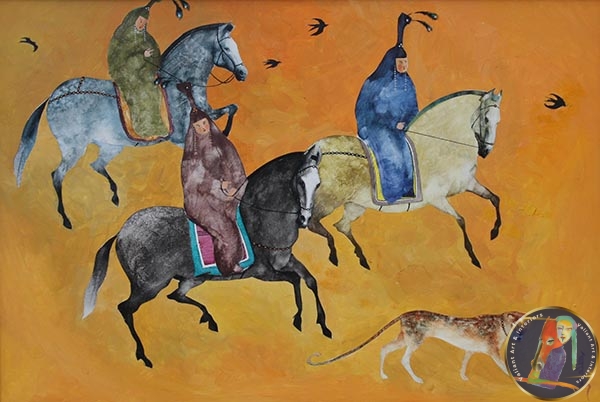
“Horse Composition 2” is a striking oil-on-canvas painting that blends traditional nomadic Mongolian iconography with a sleek, contemporary aesthetic. Measuring 40 by 60 cm, the composition features a dynamic arrangement of horses—the quintessential symbol of the Mongolian steppe—rendered not with strict realism, but through an expressive, modern lens. The artwork captures the raw energy, spirit, and cultural weight of the animal while utilizing a sophisticated color palette and stylized form characteristic of 21st-century Mongolian contemporary art.
Composition and Form
The painting prioritizes movement, rhythm, and structural harmony over exact anatomical reproduction.
Stylization: The silhouettes and musculature of the horses are interpreted through fluid, slightly abstracted lines. The curves of their necks, the powerful arch of their backs, and the suggestion of tossing manes are captured in sweeping brushstrokes, emphasizing the collective momentum of the herd rather than individual details.
Spatial Depth: Rather than employing a traditional linear perspective with a distinct horizon line, the artist utilizes a more layered, flattened space. The horses overlap and intertwine, creating a dense tapestry of forms that seems to push outward against the boundaries of the canvas. This compressed depth focuses the viewer’s full attention on the interplay of shapes and lines.
Color Palette and Light
The color choices bridge the earthy reality of the Mongolian landscape with an internal, emotional atmosphere.
Color Temperature: The palette balances warm, grounded tones—such as deep ochres, sienna, and rich chestnuts—with cooler, modern accents like muted grays, slate, or subtle undercurrents of blue and stark cream.
Chiaroscuro and Texture: Light does not originate from a single, realistic source. Instead, it seems to emit from within the canvas, highlighting the contours of the horses’ bodies and creating a dramatic play of shadows. The oil paint is applied with varied texture—smooth, deliberate fields of color contrast with areas of looser, more tactile brushwork, giving the surface a vibrant, living quality.
Atmosphere and Cultural Context
Created in 2009, this artwork reflects Undram Enkhbold’s position in the modern wave of Mongolian artists who look at their heritage through a globalized perspective. While the subject matter is deeply rooted in the ancient, nomadic relationship between the Mongol people and the horse, the execution feels entirely current. “Horse Composition 2” strips away the pastoral romance often found in traditional landscapes, replacing it with a powerful, concentrated study of form and motion that speaks to the enduring, restless energy of the steppe in the modern era.