
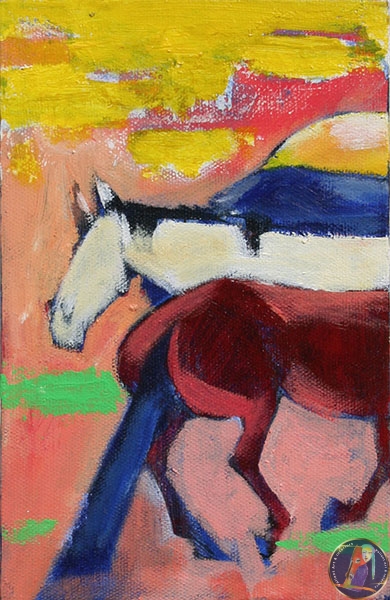
Horse Composition

Sainkhuu Enkhbat , 2009 , Oil On Canvas

Horse Composition is an intimate yet dynamically charged oil painting that captures the raw spirit, power, and cultural reverence of the Mongolian horse. Rendered on a modest 16 x 26 cm canvas, the artwork transcends its small scale through bold, expressive brushwork and a vivid, atmospheric color palette. The composition focuses on a small herd of horses moving across a vast, semi-abstract landscape, blending traditional nomadic themes with a modern, impressionistic aesthetic.

Composition and Subject Matter

The painting features a tight, energetic grouping of horses as they navigate an open terrain. Rather than rendering the animals with rigid anatomical precision, Enkhbat uses fluid, gestural strokes to emphasize motion, muscle, and vitality.

  • The Foreground & Midground: The horses dominate the lower two-thirds of the canvas. Their bodies overlap, creating a powerful sense of unity, depth, and collective momentum. Some horses are depicted with heads held high, manes catching the wind, while others blend into the collective mass of the herd. The impasto technique—thick, layered applications of oil paint—gives the horses a tangible, textured presence, making their forms feel alive and sculptural.

  • The Background: The landscape is stylized and expansive, hinting at the endless horizons of the Mongolian steppe. The horizon line is set low or intentionally blurred, fusing the earth with a dramatic, sweeping sky. The background is rendered with broader, softer brushstrokes, allowing the sharp, energetic palette-knife work of the horses to command the viewer’s attention.

Color Palette and Light

The color scheme is both earthy and dramatic, reflecting the shifting light of the open plains:

  • The Herd: A rich interplay of deep chestnuts, warm ochres, stark whites, and shadowy blues defines the coats of the horses. The contrast between light and shadow highlights their powerful musculature and the rhythmic motion of their gallop.

  • The Environment: The terrain and sky are composed of sweeping washes of amber, dusty golds, muted greens, and stormy, atmospheric grays. Hints of brilliant, unexpected color—perhaps a stroke of crimson or turquoise—suggest the fleeting glint of sunlight breaking through clouds.

Style and Atmosphere

Enkhbat’s style in Horse Composition is deeply expressive, leaning into contemporary impressionism. The brushwork is deliberate, urgent, and emotional, mirroring the wild and untamed nature of his subject. There is a profound sense of freedom and timelessness in the work; the boundaries between the horses and the landscape are fluid, suggesting that the animals are an inseparable extension of the land itself.

Despite its compact dimensions, the painting carries the weight of an epic narrative, embodying the deep-rooted equestrian heritage of Mongolia that the artist carried to international acclaim at the Carrousel Du Louvre and the International Equestrian Festival.

  • Sainkhuu Enkhbat
  • Ulaanbaatar, Mongolia
  • Abstract, Figurative, Minimalist, Modern/Contemporary, Nude
  • Oil on canvas
  • SAI56/018
  • (16 x 26cm) x 46" x 10"
  • Valiant Art & Interiors

Add Your Comment

Mongolian Art Gallery © 2025. All Rights Reserved
Privacy Policy / Terms of Use

Horse Composition is an intimate yet dynamically charged oil painting that captures the raw spirit, power, and cultural reverence of the Mongolian horse. Rendered on a modest 16 x 26 cm canvas, the artwork transcends its small scale through bold, expressive brushwork and a vivid, atmospheric color palette. The composition focuses on a small herd of horses moving across a vast, semi-abstract landscape, blending traditional nomadic themes with a modern, impressionistic aesthetic.

Composition and Subject Matter

The painting features a tight, energetic grouping of horses as they navigate an open terrain. Rather than rendering the animals with rigid anatomical precision, Enkhbat uses fluid, gestural strokes to emphasize motion, muscle, and vitality.

  • The Foreground & Midground: The horses dominate the lower two-thirds of the canvas. Their bodies overlap, creating a powerful sense of unity, depth, and collective momentum. Some horses are depicted with heads held high, manes catching the wind, while others blend into the collective mass of the herd. The impasto technique—thick, layered applications of oil paint—gives the horses a tangible, textured presence, making their forms feel alive and sculptural.

  • The Background: The landscape is stylized and expansive, hinting at the endless horizons of the Mongolian steppe. The horizon line is set low or intentionally blurred, fusing the earth with a dramatic, sweeping sky. The background is rendered with broader, softer brushstrokes, allowing the sharp, energetic palette-knife work of the horses to command the viewer’s attention.

Color Palette and Light

The color scheme is both earthy and dramatic, reflecting the shifting light of the open plains:

  • The Herd: A rich interplay of deep chestnuts, warm ochres, stark whites, and shadowy blues defines the coats of the horses. The contrast between light and shadow highlights their powerful musculature and the rhythmic motion of their gallop.

  • The Environment: The terrain and sky are composed of sweeping washes of amber, dusty golds, muted greens, and stormy, atmospheric grays. Hints of brilliant, unexpected color—perhaps a stroke of crimson or turquoise—suggest the fleeting glint of sunlight breaking through clouds.

Style and Atmosphere

Enkhbat’s style in Horse Composition is deeply expressive, leaning into contemporary impressionism. The brushwork is deliberate, urgent, and emotional, mirroring the wild and untamed nature of his subject. There is a profound sense of freedom and timelessness in the work; the boundaries between the horses and the landscape are fluid, suggesting that the animals are an inseparable extension of the land itself.

Despite its compact dimensions, the painting carries the weight of an epic narrative, embodying the deep-rooted equestrian heritage of Mongolia that the artist carried to international acclaim at the Carrousel Du Louvre and the International Equestrian Festival.