
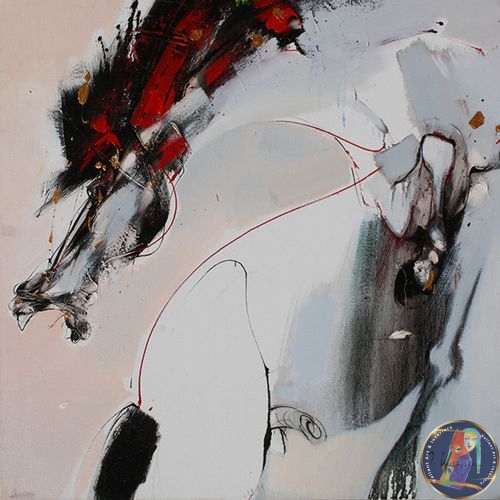
Horse Composition 1 is a compelling synthesis of Mongolia’s deep-rooted nomadic heritage and the bold, emotive language of modern abstraction. Painted in 2009, this 70 x 70cm oil on canvas reflects Enkhtaivan Ochirbat’s signature ability to bridge the gap between traditional Mongolian subject matter and Contemporary Figurative Expressionism.
Visual Breakdown
The painting moves away from literal representation, instead focusing on the dynamic energy and spiritual essence of the horse. Rather than a singular, clear-cut figure, the “composition” suggests a fluid movement of forms, where the anatomy of the horse—the curve of a neck, the power of a flank, or the sweep of a mane—is fractured and reassembled through an expressionist lens.
Color Palette: Drawing from his “Color” exhibition influences, Ochirbat likely employs a sophisticated interplay of earthy tones and vibrant accents. Expect to see the ochres and siennas of the Mongolian steppe clashing with bold, emotive strokes of blues or deep reds that signify the “Action” style he explored in the early 2000s.
Texture and Brushwork: The application of oil is likely heavy and gestural. As an artist trained in the late 90s and currently teaching art, Ochirbat demonstrates a masterful control over the medium, using thick impasto or energetic scumbling to create a sense of vibrating atmosphere around the equine forms.
Space and Form: The 70 x 70cm square format provides a balanced, contained space that emphasizes the “Composition” aspect of the title. The figures are not merely placed in a landscape; they are the landscape. The boundaries between the horse and the surrounding environment are blurred, suggesting a oneness with nature—a central theme in Mongolian art.
Artistic Context
Created during a period when Ochirbat was gaining international exposure (following exhibitions in the US, Russia, Bulgaria, and Poland), Horse Composition 1 represents a mature phase of his career. It departs from the elementary realism of his early training, leaning instead into a Contemporary Figurative Landscape style where the horse serves as a vessel for human emotion and national identity.
The work captures the “spirit of the steppe” not through a photographic lens, but through the rhythmic, almost musical arrangement of shapes that define Ochirbat’s contribution to the Union of Mongolian Artists.