
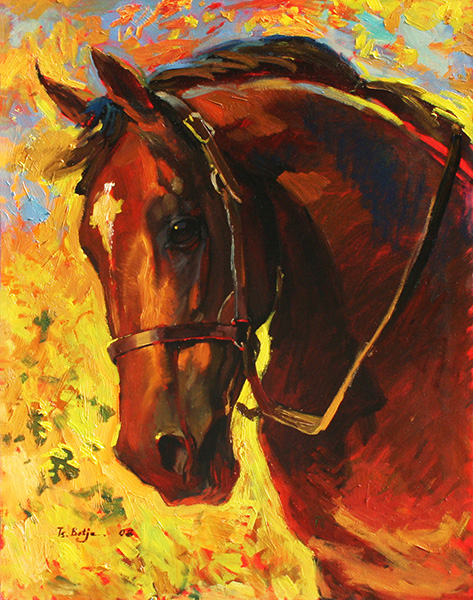
In this 2008 masterpiece, Tseintsogzol utilizes his signature photorealistic technique to capture the essence of a horse, likely set against the vast, atmospheric backdrop of the Mongolian steppe. Given the dimensions (80 x 60 cm), the composition is a vertical portrait, focusing intensely on the muscularity and spirit of the animal.
1. Subject and Composition The horse is rendered with anatomical precision. Tseintsogzol often focused on the play of light across the animal’s coat, highlighting the ripple of muscles and the fine texture of the hair. The 80 cm height allows for a commanding presence, where the horse’s gaze—steady and wild—serves as the focal point.
2. Technique and Texture
Oil on Canvas: The artist uses the slow-drying nature of oils to create seamless gradients. You can almost feel the “heat” emanating from the horse’s skin.
Photorealism: Every detail, from the moisture around the nostrils to the individual strands of the mane caught in a breeze, is executed with a clarity that rivals high-definition photography.
Nature & Realism: Unlike romanticized depictions of horses, Tseintsogzol’s work is grounded in the reality of the Mongolian landscape. There is a sense of “truth” in the dirt on the hooves or the specific way light hits a Bay or Chestnut coat at dusk.
3. Color Palette Expect a sophisticated palette of earth tones—ochres, burnt siennas, and deep umbers. These are likely contrasted against the soft, cool blues or muted greys of a Mongolian sky, creating a sense of infinite space that characterizes the artist’s homeland.
Context & Significance
Batjargal Tseintsogzol was a pivotal figure in Mongolian contemporary art. His work often bridged the gap between traditional nomadic subjects and modern technical perfection.
Cultural Symbolism: In Mongolia, the horse is not merely an animal but a symbol of freedom, heritage, and survival. By painting it in a photorealistic style, Tseintsogzol elevates the horse from a cultural icon to a living, breathing entity.
Legacy: Created in 2008, during the height of his career, this painting represents the artist at his technical peak, capturing the silent dignity of the creature that defines the Mongolian soul.
“To look at a Tseintsogzol horse is to see beyond the canvas; it is to feel the wind of the steppe and the heartbeat of a companion.”